
Sauble Beach Piping Plover Report, July 10/09
Two days ago one of the rare and endangered Piping Plover chicks was predated by a Merlin. This chick was from the south nest which bred 4 chicks this year. This is the second chick that has been lost to a Merlin from an original total of 9 hatchlings this year. Continue reading Sauble Beach Piping Plover Report, July 10/09
Piping Plover Report Sauble Beach – June 30/09
As of today, this rare and endangered species has produced 8 Piping Plover chicks from 3 separate sets of breeding parents. Continue reading Piping Plover Report Sauble Beach – June 30/09
Bruce Birding Club Outing Report – June 17/09
Places visited in the Bruce Peninsula: Continue reading Bruce Birding Club Outing Report – June 17/09
Privacy Statement
The OSFN does not collect any information about its members except that which is knowingly and specifically supplied by them. This may include name, mailing address, phone number and e-mail address. Any member who wishes to exclude certain pieces of personal information (home address, phone number or e-mail address) not essential to maintaining their membership may choose to do so. Continue reading Privacy Statement
A Guide to the Geology & Landforms of Grey & Bruce Counties
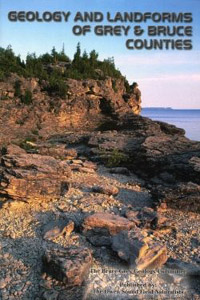 The aim of this book is to present an over-view of this subject that will be intelligible to anyone interested in this unique area. Geological formations are described first, followed by glaciation and landforms resulting from the ice age. Lake features are outlined and there is a chapter on karst formations, followed by an outline of post-glacial formations created by wind and river action.
Grey and Bruce counties are in an unusual position in Ontario, sandwiched between Lake Huron and Georgian Bay, dominated by the Niagara Escarpment and the tilt of the Michigan Basin. There are many Areas of Natural and Scientific Interest (ANSI’s) related specifically to Geology. A Geology and Landform site map with ANSI locations is included. There is also a map of the Physiography and a third of Bedrock Geology. In the appendices, locations are identified where specific features can be viewed
Please direct purchase inquiries to publications@owensoundfieldnaturalists.ca
A Checklist of Vascular Plants for Bruce & Grey Counties
 This is the definitive checklist of vascular plants for Bruce and Grey counties listing 1447 taxa (species, subspecies and hybrids) for 136 families, including 72 provincially rare. It is the only publication identifying all locally rare plants in Bruce and Grey counties, as well as provincially rare.
The two counties have been divided into three zones: Bruce Peninsula(p), Southern Bruce(b), and Grey County(g). Species presence in those zones is noted by the letters pbg in a superscript. Upper case PBG indicates very uncommon, and bolded upper case PBG indicates local rarity. Marginal symbols indicate the following categories: naturalized – non- native in Ontario; naturalized but native in Ontario; cultivation escapes; provincially rare in Ontario (NHIC); historical record.
This is an essential reference for botanists, life science inventory specialists, land use planners, resource management agencies, and consultants that are working on projects within Bruce and Grey counties.
CURRENTLY UNAVAILABLE AS A HARDCOPY
A revision & reprint is scheduled for 2023.
Donations are always appreciated!
Author: Owen Sound Field Naturalists
The Asters, Goldenrods & Fleabanes of Grey & Bruce Counties
 This book was conceived when two members of the Owen Sound Field Naturalists, Ralph and June Krueger, were having trouble with identification because there are so many species in Ontario. They were developing an Aster and Goldenrod garden. They were using John Semple’s books for Ontario which are excellent but we have only half the Ontario species. We were very fortunate that John gave us permission to use his diagrams. We did not attempt to give colour photos since asters are enormously variable. Some species range from white to dark blue so you have to go by the structure of the flower head and the leaf shape and arrangement.
The Fleabanes (Erigeron sp.) were added because another member of the Field Naturalists, Dorothy Kings, pointed out that people often confuse them with asters. There are only three species and one important rare sub-species – Provencher’ s Fleabane – which is the one illustrated on the front cover of the book. There are 15 aster species and 16 goldenrods (Solidago sp.). All these plants are members of the family which used to be called Compositae because the flowers are actually heads of two different kinds of tiny florets, the outer ones with rays , the inner ones tiny discs. The Fleabanes have narrower ray florets and more of them than the Asters. The diameter of the disc is wider in relation to the length of the petals. The goldenrod flower heads are generally much smaller and more numerous. The number of florets is much fewer.
New England Aster is a typical example of the Asters but its colour varies from pink to purple. The most familiar Goldenrods are three species in the Canada Goldenrod complex, but Grass Leaved Goldenrod with a flat topped inflorescence is also common. Whereas species like the Ontario Goldenrod, photographed on the Flowerpot Island shore, are much more habitat specific and, therefore, uncommon. Because Goldenrods bloom late in the season, many people think they cause Hay Fever. They do not have wind borne pollen, they are insect pollinated so they have sticky pollen. It is the inconspicuous, greenish ragweed, common along mown roadsides and other disturbed areas which is the culprit.
Most people are unaware that one goldenrod has white flowers. Unfortunately, its common name is the Upland White Aster! It is actually a member of the Goldenrod genus, Solidago ptarmicoides. Purchasing this slim volume will enable you to start to recognise the different species you encounter. stores.
Author: Owen Sound Field Naturalists
Please direct purchase inquiries to publications@owensoundfieldnaturalists.ca
A Guide to the Ferns of Grey & Bruce Counties
 Fifty ferns have been recorded from Grey and Bruce counties, two thirds of the fern flora of Ontario and only two fewer than the number found in the British Isles. Although the number is not great, people find them difficult to identify since they are all green and have no flowers.
The first identifying feature to view is the shape of the frond (leaf). In a few ferns the fronds are entire. A good example of this is the Hart’ s Tongue Fern. This is globally rare as, in North America, it is only found in any quantity in this area of Ontario, especially along the escarpment. There are a few remnant populations in the States. It is related to the much more common Hart’s Tongue found in Europe but, separation for thousands of years – probably by glaciation – has caused the North American population to develop into a separate sub-species.
In the picture of the Hart’s Tongue Fern, another fern can be seen just left of the centre which has the blade of the frond divided into leaflets. In ferns, these are called pinnae (singular – pinna). We refer to these ferns as once divided. This is the Northern Holly Fern so called because the pinnae are stiff and feel prickly. Another example of a once divided fern is the Polypody. This is not too common in this area as it flourishes in more acid situations but it will grow on a rock if it is covered with a good layer of humus and mosses.
The Walking fern is also an example of a fern with an undivided frond. In this case, they are very tapered and have the ability to root at the tip. Consequently, it forms dense clones. These are only found on the top of large dolostone blocks in this area.
In the Sensitive Fern the pinnules are indented but not quite divided into sub-leaflets. The Sensitive Fern is named because it is extremely sensitive to frost so that its fronds are one of the first to die and shrivel up at the beginning of autumn. In some ferns the second division is complete and the pinnae are divided into pinnules. We refer to these as twice divided. The Silvery Glade Fern is an example of this and so is the Virginia Chain Fern.
In some ferns the pinnules are further sub-divided into lobes and these are said to be thrice divided. A common example of this type of lacy fern is the Spinulose Wood Fern found in swampy forest. The Evergreen Wood Fern is similar but is found on drier forest floors, especially at the base of trees. Its fronds stay green all winter, even under the snow. The Lady Fern is also thrice cut. It is difficult to separate them until you turn them over and look at the way the sporangia (spore producing organs) are housed in the indusia. In the Spinulose and Evergreen wood ferns the indusia are little dots, in the Lady Fern they are slits which form chevrons. In the photo of the Virginia Chain Fern we are looking at the underside of the frond and we can seen the indusia tightly packed along the midrib.
There is a great deal of variation in the spore bearing organs of ferns. In some cases, like the Cinnamon Fern on the front cover of The Ferns of Grey and Bruce , the fertile frond is a totally different structure from the sterile fronds. The Cinnamon Fern is so named because the colour of the spores makes the fertile frond look like a cinnamon stick. The Sensitive Fern also has a different kind of fertile frond which remains erect and shedding spores all through the winter after the sterile fronds are long dead. In some cases, the fronds are part sterile and part fertile. The Rattlesnake Fern is an example of this. The fertile portion can be seen rising above the low-lying sterile parts.
These variations provide a means of separating the different species so that they can be identified. It is challenging but The Ferns of Grey and Bruce explains this fully and the illustrations, frond silhouettes and colour pictures facilitate this. There are only 50 species! Hunting for ferns will lead you into a variety of interesting habitats and give you a different view of the natural world.
Author: Owen Sound Field Naturalists
This Publication is currently SOLD OUT! A revision & reprint is scheduled for 2024.
Please direct purchase inquiries to publications@owensoundfieldnaturalists.ca
Exploring An Urban Forest: Owen Sound’s Heritage of Trees
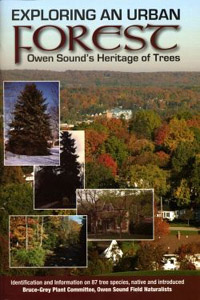
The aim of this book is to encourage people to recognize the trees
surrounding them. With greater appreciation, an understanding of their
importance to the community will develop and, hopefully, this will encourage
residents in the future to make every effort to maintain this urban forest
in a healthy condition.
The book includes sections on the history of the urban forest and its
values, how this project began, and the relationship of Owen Sound’s urban
forest to the natural forest regions of Ontario.
Some 87 trees and large shrubs are described, of which 41% are not native to
North America; 10% are Carolinian; 6% are native to North America but not
native to Ontario or the Carolinian Forest; and the remaining 43% are native
to Grey County. Many publications are currently available to help readers
identify native species, but very few are available to identify non-native
or introduced species which are typically found in urban areas such as Owen
Sound. This makes this publication very useful and not only in Owen Sound.
Most cities in eastern North America have planted the same species.
There is a written description of each species. Key identification features
are bolded. Background information is given for each tree such as uses of
the wood, how named, and preferred habitat. Sometimes specific addresses are
provided where good examples can be seen. Also included with permission are
many photos and line drawings of leaves, needles, fruits, flowers, etc. from
“Native Trees of Canada” by Hosie and “Trees in Canada” by Farrar.
An identification key has been developed for the book to allow
identification to be undertaken in a systematic way.
Another attribute is the inclusion of 4 walking tours of Owen Sound. These
are complete with detailed maps and street names and addresses where
excellent examples of the various tree species can be seen first hand. All
trees can be viewed from the street without infringing on the privacy of
residents.
Please direct purchase inquiries to publications@owensoundfieldnaturalists.ca