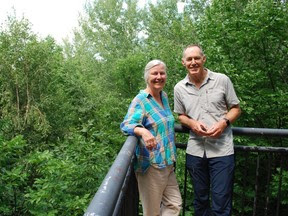
Lovers of beauty in Nature are in for a treat! In the words of the renowned former Sun Times Staff Photographer Willy Waterton –
“Last summer Audrey and I located and photographed 35 of the 48 wild orchids found in this area for an upcoming reprint of the 25 year old Canadian best seller Orchids of Bruce & Grey.This Thursday, April 14, 7pm at the Harry Lumley Bayshore Community Centre in Owen Sound, we’re excited to present this talk about our orchid quest for the Owen Sound Field Naturalists (OSFN).
The talk will also be presented live on Zoom. Please join us either at the Bayshore in person (non members, entrance by donation) or email in advance to web@osfn.ca with Orchids as subject, to receive a Zoom link to watch. Either way, come with us on the quest and enjoy the vibrant colours of summer flowers during our cold spring! Regards, Willy”
Eastern Bluebird April 10 Lindenwood Road Photo by William Gray
April can be a month of celebration and discovery as we frequently notice sounds and sights for the first time this year – the distinctive songs of Robins, Killdeer, Cardinals, Song Sparrows, the melodious Eastern Meadowlark, and for me just yesterday, my first of year Eastern Phoebe. Back to our area now, Phoebes can now be optimistic that they can find enough of the flying insects that I have been seeing, to survive the remaining uneven weather; many local observers, me included, have reported seeing their first Mourning Cloak butterflies; there are still some Pussy Willows here and there, and leaf buds on trees are swelling with moisture and energy; trout can be seen upstream in many creeks, and muskrats are often visible along the banks. When I was cycling yesterday, I heard my first Spring Peeper Frogs, saw some bright yellow Coltsfoot, and although I haven’t yet seen Wild Leeks, or Trout Lilies, when I stepped into a hardwood bush area to see if any were evident, I was delighted to see a stunningly beautiful Scarlet Cup fungus.
Scarlet Cup Fungus near Sideroad 15 – April 11, photo by John Dickson
More than half of the $5 tickets have been sold for Hap Wilson’s presentation at 2pm Sunday April 24 at the Bayshore Community Centre. Presented by OSFN and sponsored by Caframo, the prolific author, artist, and photographer Hap Wilson will deliver his 50 Years~100 Rivers: Guidebook Pathfinding keynote address to Celebrate Earth Week. Both Hap and his wife Andrea will also have his many books, including his new novel, Out of Abaddon, for sale by cash or credit card, and Hap will be glad to personalize any book purchases.However, there are still plenty of tickets at these outlets where you can obtain them in advance, before the event is sold out: Suntrail Source for Adventure in Hepworth, Meaford IDA Pharmacy, the Owen Sound Farmers’ Market, and the Owen Sound and North Grey Union Public Library. Tickets will also be available at the Orchid Quest talk on Thursday. For more details about both events and more, please visit www.osfn.ca
Earth Day Grey Bruce 2022 is an exciting new, comprehensive and inclusive community event from 1:30 to 5pm Saturday April 23 at the Owen Sound Farmers’ Market. From their website: This is a new opportunity for people in Grey Bruce to come together to share, learn and celebrate everything we want to protect. We invite everyone in our diverse community to take part in a playful, child-friendly event, including a parade, live music, art, crafts, dance and poetry. There will be booths offering information and resources on greener living, gardening, regenerative farming, mental health, nature groups and initiatives for climate action. We invite people of all ages and identities, as well as organizations and community groups from across our region, to join us. Opening Water Ceremony 1:30pm, Booths open from 2pm to 5pm, Parade 3:00pm, Live Music and Dance 4pm. For more information and details, please visit https://www.forourkids.ca/earthdaygb22
Congratulations have been pouring in for Owen Sound’s successful application to be designated a Tree City of the World, initiated by NeighbourWoods North. Kudos for all of the good work so far, and for the planning and implementation of this programme going forward.
Shawna Macivor and Lloyd Lewis of NeighbourWoods North stand in front of a backdrop of trees at the Centennial Tower in Owen Sound. The pair, along with fellow organization member Gord Edwards, asked the city to apply to become a Tree City of the World in 2021.
The weather finally cooperated on March 27, for the Young Naturalists Club to do some animal tracking with Jeff Kinchen and, as Jody Johnson Pettit shared “We followed deer, grouse, red squirrel and owl tracks in the snow.”
Photo by Jody Johnson Pettit
Photo by Jody Johnson Pettit
In addition to the more commonly seen birds, many keen birders are always noting “rare bird sightings” of species that are only occasionally, or very rarely, if ever, seen locally. In recent months, these have included Hoary Redpoll, Least Grebe, Horned Grebe, Black Scoter, Pied-billed Grebe, Ross’s Goose, Cackling Geese, Greater White-fronted Geese, Golden Eagle, Peregrine Falcon, Red-shouldered Hawk, Short Eared Owl, to name just a few.
It’s a beautiful day in the neighbourhood… Sandhill Cranes: north of Kimberley April 12 Photo by Ingrid Remkins
Bruce Birding Club (BBC) members have been sharing both their group and individual sightings of Spring bird activity. On his property, Doug Pedwell noted “While waiting out the quarantine, I have been paying attention to what is going on outside. A lone Pine Siskin seems to be travelling with the Goldfinches. Song Sparrows are already staking out nesting territories. The Starlings are already on the nest. I have found the odd Robin’s egg in various places. Today I heard my first Spring Peeper and the Wood Frogs are heading to full Chorus.” BBC coordinator Fred Jazvac confirmed “One of the behavioural characteristics of Pine Siskins is, when they are in our area, they hang out with American Goldfinches.”
So pleased to see the Great Egret back in the Valley… (North of Kimberley) April 11 Photo by Ingrid Remkins
To close, a quote from Grey Owl and Me, by Hap Wilson – “It was always about ‘the trail,’ and the ability to disconnect yourself from the things that are destroying mankind by destroying Nature…every time I stepped into the canoe, searching for lost rivers, or straddled my motorcycle and headed for the backcountry.”
Owen Sound Field Naturalists (OSFN) will offer five brief and diverse presentations for Members Night, as well as such popular audience features as “Sightings” – individuals reporting recent observations – plus community Nature news too, all starting at 7pm this Thursday at the Harry Lumley Bayshore Community Centre, and just a reminder: the wearing of masks for Covid-19 is currently required indoors at the Bayshore.
Everyone is welcome, admission is free or by donation for this event. OSFN is also planning to present the evening on zoom. OSFN club members receive the Zoom link by email. Non-members may request a Zoom link by emailing well in advance to web@osfn.ca with “Members” in the subject line.
Scheduled presenters from the club are: David Morris – In Our Own Backyard; Bill Moses – OSFN History; Marsha Courtney- Kayak Into Nature’s Beauty; Bob Knapp – A Trip to Ecuador; Peter Middleton – Wings over the Platte, Sandhill Crane Spectacular (from Nebraska).
In addition, I will have tickets available for sale, (just $5. each), for OSFN’s seventh annual Celebrate Earth Week Keynote Address, by Hap Wilson, entitled 50 YEARS ~ 100 RIVERS – Guidebook Pathfinding. It is scheduled for 2pm Sunday April 24, also at the Bayshore Community Centre. Hap Wilson is an award winning author, artist, wilderness guide and photographer, an International Fellow of the prestigious Explorer’s Club, a Fellow of the Royal Canadian Geographical Society, a recipient of the Bill Mason Award for lifetime achievement in river conservation, co-founder of the environmental group Earthroots, and much more. He and his wife Andrea will also have a selection of his books for sale at this event. I was not surprised to discover that many of our area’s fine paddlers have used Wilson’s guidebooks themselves. I have especially enjoyed the artwork that is sprinkled throughout books of his that I have encountered.
For more information about any of these events and other activities of the Owen Sound Field Naturalists, please visit www.osfn.ca
The Horned Larks are migrating now. (Photo by Bruce Edmunds) Mar 4, 2022, Kincardine area
The Bruce Birding Club has resumed its twice per month outings, enjoying the bird sightings and the camaraderie of fellow birders. From the March 2nd birding tour Fred Jazvac reported:
We had a good number of species today, especially after the long cold winter we experienced with 40 species in total. Highlights of the day included seeing two Screech Owls in different locations. The second one cooperated the most by waking up at about 3:00 p.m. and being shocked at the strange creatures staring at him. His curiosity lingered on and on at the assembled crowd who stared right back at him. Tufted Titmouse, Cackling Goose, Pine Siskin were good finds as well.
Deane Atherton recently shared his observations and helpful tips about Pine Grosbeaks sightings in Owen Sound.
Photo by Deane Atherton March 5
“Flocks of pine grosbeaks have been foraging on the fruit trees in Brooke (west side of Owen Sound) for the past few weeks. Most of the birds are typical females (yellow plumage). If you look through the flocks you’ll find a few males and russet birds. My understanding is that the russet forms are either first year males or a russet morph of female. Take a walk around Brooke if you haven’t seen these birds this winter”
Photo by Deane Atherton March 5
The Friends of Hibou have posted their new Spring Newsletter on their website. It includes news from Krista McKee about a Family Fun Day scheduled for August 7, a new song entitled Hibou, by Brian Tannahill, plus an introduction to Spring Birds at Hibou, with descriptions and photos by Peter Middleton. It is definitely worth a visit to Hibou itself, as well as to www.friendsofhibou.com
The Bruce Grey Woodlands Association is once again hosting the annual Grey Bruce Woodlot Conference that will take place virtually, via zoom, on Tuesday March 22nd and Thursday March 24th. I certainly recommend checking this out, especially as I very much enjoyed catching one evening of last year’s conference.
This year the list of presentations is as follows:
March 22nd:
7pm – Wild Boars, presented by MNR-F; 8pm – Update on Forest Health, presented by MNR-F
March 24th:
7pm – Forestry Related Applications for Landowners,with Aaron Swayze, Forestry Technician, Saugeen Conservation; 8pm – Climate Change and Forestry, with Kevin Predon, Forester, Bruce County.
To learn more about the Bruce Grey Woodlands Association visit www.bgwa.ca and to register for this conference and receive a zoom link, please email your name and address to: info@gbwc.blog
The first Common Grackle of the year. Another sign of spring. Photo by Nigel Eves, Meaford, March 7
Grey County Master Gardeners are offering their Eco-Responsible Gardener Series Seminar #3, entitled Rethinking Beauty: Inspiring Gardeners in a Changing World on March 26 at 11am, via Zoom. Join the inspiring and enthusiastic Paul Zammit as he challenges you to think about the meaning of beauty in a world of climate change and biodiversity. His hugely entertaining talks attract international audiences of all ages.
Paul is a Horticulturalist, lecturer and photographer and is currently Professor of the Horticultural Program at Niagara College, after serving as Director of Horticulture at the Toronto Botanical Garden for 10 years. In 2019 and 2021, Paul was awarded Landscape Ontario’s Garden Communicator of the Year Award.
Red-Winged Blackbirds are back and singing. Sure sign of spring Photo by Angela Milan, March 5th, west of Markdale
The Huron Fringe Birding Festival looks to me to just keep getting better, and this 24th version is set for May 27-30 and June 2-5. I encourage you to visit www.friendsofmacgregor.com where you will be able to see the impressive line-up of birding opportunities, and much more. If you just can’t wait, you can also sample the seven recorded presentations from the excellent 2021 Festival Lite. It is a good way to meet some of the personalities who will be back this year too.
Mink – photo by Ingrid Remkins March 6, north of Kimberley
I have been seeing Robins since Sunday, and also noting the buds and new growth on many saplings, and mature trees too. Wetlands are shifting from ice to open water, the planned destinations for many migrating waterfowl whose flight paths lead them here, either to rest and re-fuel for the next stage on their route, or to stay and raise their new families right here.
To close, a ‘Winter transition to Spring’ Nature quote from Morgan Llywelyn’s After Rome: “The winter dragged on… The sparse grass atop the cliffs was rimed with ice, it crunched when the horses tried to crop it…Then one morning there was a perceptible change in the angle of the light. A few days later the omnipresent wind swung around and began to blow out of the south. The horses stopped trying to tear nourishment out of the reluctant earth and lifted their heads, sniffing through distended nostrils… Spring was in the air.”
First one in the yard this year. Spring might well be on the way. Robin, Flesherton. Photo By Dave Turner, March 2
For anyone seeking a brief escape from Winter, Owen Sound Field Naturalists (OSFN) invite you to Zoom to Zanzibar: A World of Spices – A Dream Trip Realized, for a visit hosted by OSFN President Pam Kinchen, 7pm this Thursday, February 10. This is Pam’s “See it All – Before it’s Gone! Three weeks of – Pinch me – I’m really Here!” experience, Part Two. Learn about the culture, customs, wildlife, and the important role of spices in Zanzibar.
Photo by Pam Kinchen
This free, virtual presentation is open to the general public, and is available only on Zoom. OSFN club members will be sent the “ZOOM LINK”. Non-Members and the General Public may request a “ZOOM LINK” in advance by emailing web@osfn.ca with “Zanzibar” in the subject line.
Many of these Zoom presentations have been recorded and posted on the OSFN Youtube channel, for viewing at your leisure. These include Pam Kinchen’s talk and photo tour of Tanzania (Part One) from last year, plus the Gitche-Name-Wikwedong Great Sturgeon Bay presentation from this past September, and many more.
I am also announcing that environmentalist, author, artist and explorer Hap Wilson is the keynote speaker for the 7th Annual OSFN Celebrate Earth Day/Earth Week event which is scheduled to take place at 2pm Sunday April 24, 2022 at the Bayshore Community Centre, and is, once again, sponsored by Caframo. Entitled 50 YEARS ~ 100 RIVERS: Guidebook Pathfinding, popular guide Hap Wilson’s talk will cover: Fifty years in conservation, mapping Canadian wilderness and covering almost half the land-mass in the country. The ups and downs of guidebook writing as an environmental tool. Working with and against a political mindset that affects the integrity and sanctity of our wild places. Working with First Nations in understanding the importance of traditional territories and respect for sacred places.
Details about attending this event will be shared in this space when we have greater clarity on the public health guidelines in place in April.
A mink seen recently on the Beaver River, north of Kimberley (Photo By Ingrid Remkins)
The Escarpment Biosphere Conservancy (EBC) continues to celebrate 25 years of conservation, and has also selected Robert Burcher as its Volunteer of the Month, in recognition of his position as a steward of EBC’s Trout Hollow Nature Reserve in Meaford. Robert has been visiting the area for the last 30 years and giving history tours on site for the last 20. Robert is also well known to OSFN as a leader for field trips, a lecturer and an author, specializing in the activities of naturalist John Muir in Ontario and in the Meaford area in the 1860s. Again, congratulations to Robert and to EBC!
EBC’s Volunteer of the Month: Robert Burcher giving a tour of Trout Hollow Nature Reserve.
Continuing their free virtual Seminar Series, Grey County Master Gardeners present Seminar 2: Gardening for Wildlife on Saturday February 26, at 11:00a.m. via Zoom, featuring Laura Thomas of Hidden Habitat, a nursery of Ontario native plants. Laura also provides ecological landscaping and design for the home gardener. She graduated from the University of Waterloo’s Environment and Resource Studies program, is a Certified Master Naturalist and will present on strategies to attract wildlife to the home garden, the importance of native plants, which ones are preferable and how to create beautiful and functional wildlife spaces. For more information and to register, please visit www.greycountymastergardeners.com
Feeding Wild Turkeys…around Grey Road 3, Jan 29 (photo by Fely Clarke)
A joint project of the Cornell Lab of Ornithology, the National Audubon Society, and Birds Canada, the Great Backyard Bird Count is back for its 25th year in 2022, beginning on Friday, February 18th and continuing until Monday, February 22nd (Family Day).
The Great Backyard Bird Count is an annual four-day event that engages bird enthusiasts of all ages around the world in counting birds to create a real-time snapshot of where the birds are. Anyone can participate, from beginners to experts. You can count for as little as 15 minutes on a single day, or for as long as you like each day of the event. It’s free, fun, and easy – and it helps the birds! The Great Backyard Bird Count is a joint program of the Cornell Lab of Ornithology and Audubon with Canadian partner Birds Canada.
Visit Great Backyard Bird Count to learn more and get started!For more information contact: Kerrie Wilcox Great Backyard Bird Count Coordinator kwilcox@birdscanada.org
Cedar Waxwing – February 7, Owen Sound (photo by William Gray)Snowy Owl photo by Catherine Tolton, Bruce County, January 24
To close, two Nature quotes from Sherlock Holmes, as scripted for him by Arthur Conan Doyle – “One’s ideas must be as broad as Nature if they are to interpret Nature.” and “How sweet the morning air is! See how that one little cloud floats like a pink feather from some gigantic flamingo. Now the red rim of the sun pushes itself over the London cloud bank. … How small we feel … in the presence of the great elemental forces of Nature!”
Red-tailed Hawk February 7, Owen Sound area (photo by William Gray)
Owen Sound Field Naturalists (OSFN) offer a special and free presentation entitled Regeneration through Fire: The role of burns in alvar habitat, only on ZOOM, starting at 7PM Thursday January 13.
Emma Horrigan, Conservation Projects and Education Manager at Ontario Nature, will guide you through the prescribed burn process recently undertaken at Stone Road Alvar Nature Reserve, on Pelee Island, including the rationales, the risks, and the rewards along the way. Of note, Ontario Nature originally acquired the Stone Road Alvar property through a campaign spearheaded by Dr. Stewart Hilts (a resident of Meaford) and Donald Kirk. When I was birding there in Spring a few years ago I could see the exposed limestone bedrock, thin soil, and flooded sections that are all home to species adapted to this environment, but also under threat, from time to time, from encroaching forests and invasive species.
Discover too, another important local contribution to these activities with Jason Sickel, the Prescribed Burn Consultant and Burn Boss for Lands & Forests Consulting, who coordinated this last burn on Pelee Island.
OSFN club members will be sent the “ZOOM LINK” – Non Members and the General Public may request a “ZOOM LINK” in advance by emailing web@osfn.ca with “fire” in the subject line.
Ontario Nature (ON) is also offering a webinar about the Youth Circle for Mother Earth project featuring ON staff and young environmental leaders, along with Plenty Canada, the Indigenous Environmental Institute at Trent University, and Walpole Island Land Trust. This project supports a cross-cultural network of young Indigenous and non-Indigenous environmental leaders to become lifelong ambassadors for nature.
Each of the project partners will share information about their organizations and conservation projects. These presentations will be followed by a short panel discussion with Indigenous and non-Indigenous youth. Hear from some of Ontario’s youngest environmentalists and learn how they are working with conservation organizations across the province to protect the environment. The webinar is on January 18 and will run from 6– 7:30pm Register today and/or email info@ontarionature.org
The approaching bad weather brought this colourful guy back to the feeders after a bit of an absence. Nice to see him again by Les Anderson Male Northern Cardinal Allenford January 9Once again the infamous Allenford “flying” squirrel was storming my feeder. The lust for sunflower seeds knows no bounds.. (and he stuck the landing) Les Anderson also January 9
Grey County Master Gardeners will continue their free virtual Seminar Series for 2022 with “Drip-Dry – Water-Friendly Plants and Gardens” on January 29 at 11am via Zoom.This seminar will be presented by Sean James, who was named Landscape Ontario’s Garden Communicator of the Year in 2020-2021. Sean will talk about Fusion Gardening for the home gardener, which blends rainwater management and horticulture, using native Ontario plants. Fusion Gardens are beautiful but water efficient landscapes that optimize storm water management and enhance the environment. To register , please visit – www.greycountymastergardeners.com
In 2016 I had the great fortune to meet Daphne Solecki, and share with her about the OSFN Young Naturalists Club activities, and our new Celebrate Earth Day event. I also learned about her – “I ‘discovered’ nature only in my 50’s. I have been running full tilt ever since to catch up on what I have missed and to help others to discover their passion for loving, understanding, and conserving nature.” – and her work with Nature and Youth in British Columbia. Her deep sense of connection to the natural world provided her with some of the most magical experiences of her life. Through her involvement with Nature Vancouver, and the Federation of BC Naturalists, she worked on many projects, including the creation of the Nature House at Stanley Park and, most dear to her heart, NatureKids BC, an organization that she founded and nurtured for decades. Through their motto, “To know nature and keep it worth knowing” NatureKids has supported thousands of children and their families in BC to learn about and protect nature.
She was also the recipient of the Government of BC Arbor Vitae Environmental Award, the BC Achievement Award, and the Queen’s Golden Jubilee Medal. From my email to her shortly after our visit – “Your shining example, and your enthusiasm are my inspiration, and I thank you for showing what can be done.” Daphne Solecki passed away in August of 2021.
Daphne Solecki (Supplied Photo)
Many thanks to the compilers and teams of the recent Christmas Bird Counts. Here are excerpts from some of their reports:
The annual Christmas Bird Count in Bruce Peninsula National Park took place on December 15, 2021, and recorded an above average number of species. A total of 1400 individual birds from 42 different species were spotted. Some of the highlights included sightings of:
· Birds of prey, including one (1) Red-tailed Hawk and two (2) Rough-legged Hawk;
· Four different species of woodpeckers, including five (5) Downy Woodpeckers, five (5) Red-bellied Woodpeckers, three (3) Hairy Woodpeckers, and three (3) Pileated Woodpeckers;
· Many regular bird inhabitants, including 467 Black-capped Chickadees, 221 American Goldfinches, 75 Rock Pigeons, 69 Common Goldeneyes, 49 Red-breasted Nuthatches, 47 Wild Turkeys, 36 Blue Jays, 33 Snow Buntings, 32 Ruffed Grouse, and 28 American Crows.
Bruce Peninsula National Park Christmas Bird Count volunteers spotted a couple of uncommon winter species for this area, including a Winter Wren and a Lapland Longspur. Neither of these species had been recorded on this count in the past decade. A Townsend Solitaire, a rare visitor from the west, was seen in Tobermory two days before the count and again after the count, but unfortunately was not spotted on the actual count day.
Thirteen (13) Bald Eagles were a record high number for this Christmas Bird Count. This reflects the slow but continuing recovery that this species has been making in North America over the last 50 years.
Compilers – Tanya Markvart, Tyler Miller
Kincardine’s 41st CBC was held on Thursday Dec.16, 2021. Unfortunately a one day wind event hampered searchers’ efforts. Luckily, mild temperatures and lack of snow made all secondary roads passable and still water was not frozen. The 56 species found is average but the total number of birds counted was way low. Our group didn’t even see a woodpecker all day. The high winds kept birds out of sight. The count day’s weather gets recorded and tabulated into graphs of birds per man hour. This helps researchers understand why the low number of birds was found. Highlights include two new species to the Kincardine count, Turkey Vulture(TVs) and Indigo Bunting. Two other rare birds seen on the count were Tufted Titmouse and Red-headed Woodpecker.
KINCARDINE CHRISTMAS BIRD COUNT 2021
SPECIES
Total #
SPECIES
Total #
Canada Goose
1861
Merlin
1
Tundra Swan
17
Northern Shrike
2
Northern Shoveler
1
Blue Jay
8
Gadwall
1
American Crow
686
Mallard
41
Common Raven
6
Northern Pintail
26
Black-capped Chickadee
178
Greater Scaup
1
Tufted Titmouse
1
Lesser Scaup
9
Golden-crowned Kinglet
2
Long-tailed Duck
23
Red-breasted Nuthatch
2
Bufflehead
38
White-breasted Nuthatch
5
Common Goldeneye
162
European Starling
1071
Common Merganser
7
American Robin
3
Red-breasted Merganser
61
Cedar Waxwing
78
Wild Turkey
16
House Sparrow
32
Rock Pigeon
115
House Finch
1
Mourning Dove
26
Common Redpoll
6
Ring-billed Gull
1343
American Goldfinch
142
Herring Gull
729
Lapland Longspur
2
Glaucous Gull
1
Snow Bunting
197
Great Black-backed Gull
4
American Tree Sparrow
11
Turkey Vulture
1
Dark-eyed Junco
144
Northern Harrier
3
White-crowned Sparrow
4
Sharp-shinned Hawk
2
White-throated Sparrow
3
Bald Eagle
8
Common Grackle
1
Red-tailed Hawk
4
Northern Cardinal
21
Rough-legged Hawk
2
Indigo Bunting
1
Snowy Owl
8
TOTAL SPECIES
56
Red-bellied Woodpecker
2
Downy Woodpecker
3
Hairy Woodpecker
2
The following birds were seen during count week but not on count day: Cackling Goose, Sandhill Crane, Cooper’s Hawk, Red-headed Woodpecker, Pileated Woodpecker, Brown-headed Cowbird, Purple Finch.
Compiler – James Turland
First ever Turkey Vulture on a Kincardine Christmas Bird Count. This immature bird has a black featherless head, when adult the head will be red. Photo J Turland
Vagrant Indigo Bunting found at feeder on KCBC. Note blue tail. Photo J Turland
Enhanced photo of the same Indigo Bunting shows hidden blue. Photo J Turland
Tufted Titmouse is a regular visitor to the feeder. Photo O Visser
The eleventh annual Neyaashiinigmiing (Cape Croker) Christmas Bird Count was held Saturday, December 18, along the spectacular southeastern coast of the Saugeen (Bruce) Peninsula.
Sixteen participants tallied a total of 39 species, very close to the average of 39.7. The 1,034 individual birds counted was very close to the average of 1,027. There were no big surprises, but a Northern Saw- whet Owl (only the second-ever count) and nine Pine Grosbeaks were nice finds.
High counts were tallied for five species: Ring-billed Gull (30 reported at the Nawash dump, previous high 9), Red-tailed Hawk (4, previous high 1), Rough-legged Hawk (4, ties previous high), Great Horned Owl (4, previous high 3) and Common Redpoll (87, previous high 68).
Low counts were recorded for Long-tailed Duck (1, average 12), Herring Gull (46, average 139) and Golden-crowned Kinglet (3, average 9, or is this a measure of ageing ears?). Notable misses were Horned Grebe, Pileated Woodpecker and Brown Creeper (each missed on only one previous count). Winter finches were limited to the Common Redpolls and Pine Grosbeaks, although a flyover flock of 45 “finch sp.” imparted a boreal vibe.
Count week birds included a Snowy Owl and Ring-necked Pheasant. Chi Miigwetch to Neyaashiinigmiing First Nation community for hosting this always special birding event.
Compilers – Jarmo Jalava and Miptoon (Anthony Chegahno)
Another winter first at the feeders today, Common Redpoll, Flesherton. January 9 (Photo by David Turner) Punk rock bird. Flesherton. January 9 – Female Northern Cardinal (Photo by David Turner)
Several groups did find some excellent birds during their travels, including a new record high count for Common Raven with 15 birds, and one new species was added to the growing count day total when a Hermit Thrush was observed outside of Walkerton by a party of birders who also located 3 Eastern Bluebirds. Other highlights included 1 Short- Eared Owl, last seen in 1999, and 1 Winter Wren, last seen in 1988. A total of 48 species were recorded on count day with 3 additional species being observed during count week – Snowy Owl, Belted Kingfisher, and a Ring-Necked Pheasant. A total of 6050 individuals were tallied during the count day. A special thanks to the counters in the field who made the day as successful as it was.
Compiler – Gerard McNaughton
The 2021-2022 Christmas Bird Count marked the 51st year of the Owen Sound count. On December 18th, 38 participants tallied 10,236 individuals of 61 species. The total number of individuals was up this year compared to last year, however the species count was lower.
Some highlights from this year’s count include a Green-winged Teal, Red-throated Loon, over 700 Sandhill Cranes, 6 Eastern Bluebirds and a White-winged Crossbill. This count also marks the first ever in which Sandhill Cranes were found! Once again, the now familiar Barrow’s Goldeneye of Owen Sound Harbour made an appearance, this being the fifth count in a row it’s been seen. Apart from the cranes, two other species were also counted in higher numbers than ever before: Canada Goose ( 2533) and Mallard (1560). This was likely due to the lack of snow-covered fields in the area during the count. The only notable low count for a species this year was that of the Bufflehead, with only nine individuals being found.
An additional 4 species were seen during the count week but not on count day: Northern Pintail, Short-eared Owl, White-throated Sparrow and Pine Grosbeak.
Compiler – Erik Van Den Kieboom
The 47th Wiarton Christmas Bird Count was held on Sunday, December 19, 2021 (the 50th anniversary of the count, but the count was not run on three years).
Eighteen participants and three feeder watchers tallied 60 species, well above the long-term and 10 year averages of 50 and 53 species, respectively, but just shy of the record of 62 set in 2018. The total of 4,858 individual birds was also much higher than the overall (3,431) and 10-year (4,185) averages. One new species, Yellow-rumped Warbler, was recorded (although this species has been reported once before during count week). This raises the overall count day total to 130 species (plus 6 additional count week species). Other good finds this year included Merlin (2nd ever count), two Golden Eagles (5th count, high total), Northern Goshawk (15th count) and Red-winged Blackbird (5 th count).
Record high numbers were recorded for: Canada Goose (1,329, previous high 1,157 — a species that was absent most years prior to 1997!); Mute Swan (23, previous high 16, another recent exploder); Black Scoter (3, ties previous high); Eastern Screech-Owl (7, ties previous, but more owling effort would undoubtedly yield much higher numbers); Pileated Woodpecker (13, previous high 12); and Dark-eyed Junco (102, crushing the previous high of 70).
Winter finches were limited to just five Pine Grosbeaks, one Pine Siskin, one Purple Finch and 58 Common Redpolls, but American Goldfinches were at feeders in reasonable numbers. Thanks to all the volunteers for their efforts!
Compiler – Jarmo Jalava
Meaford CBC, Tuesday, December 28, 2021
Well congratulations everyone! This year you broke the record for the total number of species ever recorded on a Meaford CBC over its 51 years!. Collectively, you tallied 61 species, 1 more than the record set back in 1975, when 60 species were found.
New record highs were set as well, with Bald Eagle being perhaps the most notable. A total of 11 were sighted, topping the previous high by 6 birds. The Eastern Bluebird 8-bird total was 6 more than the previous high.
One new species was added to the all-time list – a major find – Pacific Loon. This brings the cumulative total for the Count to 124 species. Somewhat notable finds included Northern Shoveler, Northern Pintail, Belted Kingfisher, Northern Flicker, Field Sparrow, White-throated Sparrow, Pine Grosbeak and Red Crossbill.
Winter gulls were scarce. Only 1 Glaucous was found, and for the one of the few times over the past 30 years, no Great Black-backed Gull was counted. Also missing were Pileated Woodpecker and American Kestrel – birds that are usually recorded each count. Thanks again everyone for your record-breaking work, and a Happy, Birdy New Year to all.
Compiler – Lynne Richardson
Northern Shrike January 6, by William Gray in Georgian Bluffs
Pike Bay CBC – December 29th, 2021 (now in its 8th year)
– weather: around freezing, mostly open water, short periods of light snow and rain, cloudy, a few centimeters of snow on ground (overall good conditions, with a few short periods of difficult observation) – 19 participants – 57 species (previous high of 55 set in 2015; well above 7 year average of 42) – 4 additional count week species; Glaucous Gull, Purple Finch, Hoary Redpoll, Common Grackle – 5212 individuals (well above previous high of 3290 in 2014; 7 year average is 2297) – New to count: Common Loon, Eastern Screech-Owls, Great Horned Owl, Peregrine Falcon – other notables: Cooper’s Hawk, Ring-necked Ducks, Snowy Owls, 1261 Canada Geese (prev. high of 319) Compiler – Andrew Keaveney
Cape Chin CBC – December 30th, 2021 (now in its 6th year)
– weather: few degrees below zero, very light winds, mix of sun and clouds with some clearer periods, no precipitation (overall excellent conditions to be out and recording wildlife) – 21 participants – 41 species (previous record of 37 from 2016, 2020; average of 35) – 3 additional count week species; Golden Eagle, Cooper’s Hawk, Bohemian Waxwing – 2465 individuals (previous high of 1559 in 2016; 5 year average is 1388) – New to count: Northern Flicker, Northern Mockingbird, Sharp-shinned Hawk – other notables: Snowy Owl, double-digit Red-necked and Horned Grebe numbers
The elusive Barred Owl has still never been recorded on either count despite residing in the areas mature deciduous forests. This year however, the night conditions were excellent for listening for owls on the Pike Bay CBC and this resulted in both Eastern Screech-Owls and Great Horned Owl being recorded for the first time.
The two counts collectively totaled 67 species over the 1 week period, which gives wildlife enthusiasts an excellent idea of what species are present on the central Bruce Peninsula this time of year.
Compiler – Andrew Keaveney
Common Redpoll – January 14 (Photo by John Dickson)
The Owen Sound Field Naturalists’ (OSFN) Audrey Armstrong, whose great passion is monarch butterflies, will present Monarchs: Concerns & Conservation, in hybrid form (live, in person plus via Zoom) at the Bayshore Community Centre.This illustrated talk, at 7PM Thursday, December 9, with photography by Willy Waterton, will include: an update on the status of the population; conservation strategies and recent scientific research concerning monarch butterflies; plus, descriptions of the monarch’s lifecycle here in Bruce Grey, in California and at overwintering sites in Mexico. Learn how you can help with conservation efforts and habitat creation in your own back yard! This event is open to the public, and those attending at the Bayshore are reminded to be fully vaxxed with proof, plus screening and wear masks. Audrey says “I am bringing seeds of Swamp Milkweed, (asclepias incarnata) to give away at the in person meeting.” In addition, Audrey will have OSFN’s popular books available as suitable gifts, even for yourself, and for the naturalists you know.
The club also plans, once more, to provide the programme virtually on Zoom. Those who have not received a zoom link via email, (non-members), but are interested in participating in the Zoom version may request a zoom link in advance via email to web@osfn.ca, with Monarch in the subject line. For more details about OSFN’s events, publications, Young Naturalist Club, plus club membership and support opportunities, please visit www.osfn.ca
Bob Gray tells me that the Georgian Bluffs Climate Action Team (GBCAT) is inviting people to consider joining Four Books to Heal the World, a virtual book club session whose main purpose is, through discussion, to gently guide the readers towards hope, as opposed to despair, regarding climate change. For this opening session they have selected 4 books for the messages they carry, and solutions for issues we are facing today. “Come and spend some of your winter, reading and thinking together. Register individually to join a group of 6 to 8 others (or register with friends). Time is from 7 to 8:30 PM on Zoom.”
The books and their dates are: Dec.14th – Braiding Sweetgrass: Robin Wall Kimmerer; Jan.11th – Sand Talk: Tyson Yunkaporta; Feb. 8th – To Speak for the Trees: Diana Beresford-Kroeger; Mar. 8th – Finding the Mother Tree: Suzanne Simard. For those who have limited time to read, links to summaries/study guides and videos will be provided so that everyone can join in the conversations. Registration is free. Click here to register in advance to join the Book Club. For registration information and to learn more about the work and events of the team contact: a2gbcat@bmts.com and/or visit their Facebook page.
Coincidentally, I have just started reading Braiding Sweetgrass, having enjoyed the author’s earlier work, Gathering Moss.
The NeighbourWoods North Team has had a tremendously busy and successful year in spite of the pandemic. Many trees were planted and mulched by volunteers throughout 2021. The Welcoming Gardens projects were advanced even more, with lansdcaping, and fall planting too. Lloyd Lewis has shared these 2021 accomplishments on various aspectsof their work: The Forest of Hope and Healing: Maintenance of the 4000 tree forest through wrapping, mulching and watering; planting of an additional 200 tree saplings and 10 large trees; Creation of a 200 metre mulched trail through the forest. The Healing Pathway: Creation of meadow garden south of the helipad with a variety of native pollinators; Planting a further 15 trees along the pathway. The Welcoming Garden (WG): The completion of the WG with final plantings and the donation of two giant boulders courtesy of Hutton Landscaping. Also, the addition of permanent signage acknowledging the sponsors and the purpose of the garden. A celebration of the garden took place in July. Saving a Woodlot: Hearing the news of the hospital plans to destroy a mature woodlot in the South East corner and build a new staff parking lot, we lobbied to redirect the decision. Fortunately, they re-evaluated and the woodlot was saved. Replanting Trees: The new staff parking lot location meant we had to move, by hand, 30 small trees and we hired a company to dig and replant 25 trees of about 8-10 ft in height. Tree City of the World: 8 Ontario Cities are given the status of “Tree City of the World.” We presented the idea to the City Council and they approved the idea to apply for this status in 2022. Landscaping the Grey County Administration Building: Work has begun to engage the County in the idea of landscaping the County office building into a more natural, sustainable and welcoming environment. The Future: Complete the work on the hospital meadow garden; Install artwork in the welcoming garden; Excavate the Healing Pathway around the helipad in a gravel wheelchair accessible route; Design the pathway south of the new hospital staff parking lot; Continue our work with the County property. To learn about and/or support these important endeavours please visit www.neighbourwoodsnorth.com
In the October newsletter of the Ontario Field Ornithologists (OFO), an article about distinguishing Trumpeter Swans from Tundra Swans was especially interesting to me, as I had seen Tundra Swans in greater detail this year than usual, at Lake Eugenia. However, even more intriguing to me was that this clear and comprehensive essay was authored by our own Kiah Jasper, Just five years ago a message in my inbox went like this “Greetings, My name is Kiah Jasper. I am a 14 year old wildlife photographer from the Bruce. I have enjoyed birding since I was young and am particularly interested in raptors. So far I have seen and photographed eagles and a number of hawks. For over a year now I have been looking for owls… I have looked through a lot of wooded trails for whitewash and pellets but have found nothing. Is there any advice you would have for finding owls? Any suggestions are appreciated! Thanks, Kiah”
Luckily, we were able to connect Kiah to knowledgeable and helpful mentors who took him under their wings. With his innate talents and work ethic, since that time Kiah’s name has become very well known in birding circles. He soon started a blog, where his writing skills, his superb photos plus highlights from his many sightings were on display. He has played leading roles for the Bruce Birding Club, OSFN, the Breeding Bird Atlas, Christmas Bird Counts, and as I discovered, he is now on the Board of Directors of OFO. Congratulations to Kiah, on this new position and also for, on November 14, recording the first ever sighting in Grey County, of a Black-legged Kittiwake during the OSFN’s Birding Around the Bay, also led this year by Kiah.
Nigel Eves, Kiah Jasper and David Turner enjoying the birding day, November 14th (Photo by John Dickson) At the Bayshore, November 14th (Photo by John Dickson)
The Friends of Hibou have produced their latest newsletter, which can be found at www.friendsofhibou.com Here is an excerpt: What New Things Are in the Works? The Friends of Hibou feel we have done well through the Pandemic. When we could be dragged down by Covid and Climate Change, we have the Hibou Conservation Area to help fill our souls and replenish our spirit. Getting outdoors and walking in nature has been nourishing. Many comment on how fortunate we are to live in this region and have such great areas to visit. We have been challenged by weather and restrictions when offering scheduled hikes, so we are going to try something different. Many of you venture out on foot, snowshoes or skis on your own, and that is great. Others prefer to have a leader. If you have a group of 4 or5 people and want a led hike, let us know and one of us will find a mutually agreeable date and time to lead the hike for you. Contact us at friendsofhibou@rogers.com.
Dark-eyed Junco (Photo by Carol L. Edwards)Black-capped Chickadee (Photo by Carol L. Edwards) House Finch (Photo by Carol L. Edwards)
Congratulations to the Escarpment Biosphere Conservancy (EBC) with local highlights in recent months including the Grand Openings of Trout Hollow Nature Reserve near Meaford (John Muir’s Canadian outpost) and the Orlowski Nature Reserve on the Rankin River. Led by Bob Barnett “In December, EBC begins to celebrate its 25th anniversary! 2021 has been the most invigorating time in my 34 year conservation experience. By the end of this year we hope to complete 17 projects, protecting 3,573 acres (14.5 sq.km. of land). By comparison, it took EBC from 1997 to 2004 to conserve our first 3,500 acres!” To learn more visit https://escarpment.ca/
Marsha Courtney shared this report about the Young Naturalists who were learning about Nature and History too, November 28th, “on an exciting hike through the Silent Valley Nature Reserve. We saw the Wilsons’ well that is still intact after 150 years, we explored for the fossils that Ron Savage lists in his Silent Valley book and we saw the Cessna remains from its crash there in 1970. There has also been a vigilant beaver wreaking havoc, damming the pond and it has overflowed the boardwalk that is used to get in.” Registration is open for the Young Naturalists Club! Do you know a child who loves the outdoors and exploring nature? The Young Naturalists Club is looking for members and is geared towards children aged 7 to 12 years old, however, younger and older children are welcome! The club typically meets once a month from September to June. Registration is $20/person or $40/family. Upcoming schedule: January 23 – Woodford snowshoe and animal tracking; February 27 – Snowshoe hike at Greystone Trails; March 27 – Hike at Trout Hollow; April 24 – Spring birding and hike at Keppel Croft Gardens in Big Bay; May 29 – Huron Fringe Birding Festival at MacGregor Point Provincial Park; June 26 – Flora and fauna at Petrel Point Nature Reserve and Oliphant Fen. For more information about the Young Naturalists or to register, contact Jody Johnson at 519-370-2000, jljohnson@hotmail.com or visit www.osfn.ca
Young Naturalists outing at Silent Valley Nature Reserve November 28, photo by Jody Johnson PettitHoneycomb Fossil at Silent Valley Nature Reserve November 28 photo by Marsha CourtneyYoung Naturalists at Silent Valley November 28 – photo by Marsha Courtney
The Annual Christmas Bird Counts (CBCs) will be happening throughout our region from Dec 14, 2021 to Jan 5, 2022
Keen birders are invited to participate in CBC’s across Grey-Bruce. Counts are held on different dates throughout the CBC period in Owen Sound, Meaford, Saugeen Shores, Kincardine, Hanover, Wiarton, Pike Bay, Cape Chin & Bruce National Park. Visit this link and zoom in to find a CBC near you.
November 19 near Kimberley (Photo by Ingrid Remkins)November 29 Near Kimberley (Photo by Ingrid Remkins)
Librarian, author and historian Andrew Armitage, who passed away November 18, was also a keen naturalist. In the fall of 1988, Armitage hosted and chaired at the Library, a meeting from which emerged the Owen Sound Field Naturalists, with his wife Lorraine Brown as the first President. The club held its inaugural Indoor Meeting in January of 1989, featuring guest presenter Doug Larson, a U of Guelph professor whose research had revealed the great age of many of the Cedar trees on the sides of the Niagara Escarpment. He returned as a guest speaker in the 20th season, and again in the 30th, to Celebrate Earth Week. Here Larson tells us of his remembrances of Andrew Armitage and Lorraine Brown (1949 -2012).
“Hey John,
Nice to hear from you but sad to hear of Andrew’s passing. As I get older ,,, I realize that most things that I like are rooted in the past. The deep dark past. Friends, colleagues, pieces of scientific literature, music – all the stuff that is important to me – is in the past. When I was invited by Andrew and Lorraine to give that first talk, all of our work on the escarpment was just starting. And it was thrilling to have such weird work so immediately embraced by people. I can still hear their voices arguing that what we were doing was going to change the way people looked at the escarpment and that we should be proud of that. I took it as a gross exaggeration offered by very sweet people. But they were smart, they were kind, and they were right! I was 39 when all that happened and now I’m almost 73. Yikes! But at least once a month I have people contact me about the ancient forest and its significance. So Andrew and Lorraine both knew something deep within themselves that a younger version of me could not see. Which brings me to Tom Thomson and the conversations that Andrew, Lorraine and I had about him while I was staying at their house in 1989.
They argued that all good art, and they supposed all good science, is not at all looking back – but is looking forward and imagining a world that could exist.
So I guess their message to me from 1989 to now is – do not look to the past for excitement and hope. Look forward and build on the past.”
The Owen Sound Field Naturalists’ (OSFN) featured guest Jenna McGuire, will be at the Bayshore Community Centre, now at full capacity, at 7PM Thursday November 11. Through her live, in person presentation Exploring the Geology of the North Shore, Manitoulin Island and Lake Superior, she will be sharing what she has learned exploring the geology to the north of Grey-Bruce and how it ties into local geological and cultural stories.“I’m really looking forward to it. I have spent most of the pandemic engrossed in studying the origins and mineral nature of the glacial erratics of the area.”
Jenna McGuire (Supplied photo)
Jenna will also bring a variety of local and northern specimens with her for viewing. This event is open to the public, and those attending at the Bayshore are reminded to be fully vaxxed with proof, plus screening and wear masks. Visit www.osfn.ca The club also plans, once more, to provide the program virtually to those who are unable to attend in person. Anyone who has not received a zoom link via email, (non-members), but is interested in participating in the Zoom version is invited to email web@osfn.ca, with McGuire in the subject line.
Photo by Jenna McGuire
Stephane Menu, Station Scientist at the Bruce Peninsula Bird Observatory (BPBO), included this eloquent and exciting paragraph in his recent blog:
“The morning of October 29 dawned overcast and windy, conditions that did not change over the course of the day. The strong East wind blew relentlessly all day whipping Georgian Bay in a frothy fury. As in the previous days, a few flocks of White-winged Crossbills appeared at first light, however it quickly became clear that October 29 was going to be different. Soon we were witnessing in amazement a near constant stream of low, fast-flying flocks of chattering White-winged Crossbills, all heading East against the strong wind, barely clearing the tree tops, occasionally stopping for a very short time. The River of Crossbills was at its highest flow between 8:30 and 10:00am when a befuddled but delighted team counted over 1500 of them as flocks after flocks flew over Cabot Head. The total for the day was 2500 White-winged Crossbills, an estimate of course, but one we felt was a conservative one. All the flocks were flying against the wind and none were seen going the other way. I have never seen anything like it in 16 years at Cabot Head. To think that a few days ago we were impressed with a total of 130 White-winged Crossbills! The following day, October 30, we counted about 400 White-winged Crossbills, a very respectable number but one that felt anticlimactic after the previous amazing show. On the last day of the fall migration monitoring, October 31, one small group of 20 White-winged Crossbills was seen. We wonder where all these birds came from and where they were headed.”
“Giving itself a Covid test?” October 31st, near Kimberley (Photo By Ingrid Remkins)“I have been hearing this wee but pugnacious bird for the past week. Today I finally saw it… Northern Shrike” North of Kimberley November 8 (Photo By Ingrid Remkins)
Perhaps some of those Crossbills made it to Collingwood where about 50 of them were observed on October 30, by an OSFN birding group led by David Turner. Earlier highlights in the Clarksburg area included a Greater Yellowlegs, the only one I have seen this year.
Other recent sightings have included Snakes, sunning themselves on roadways, paths, shorelines, in wooded areas and even on a deck. Bob Knapp observed a Water Snake near Cabot Head on October 28, and an Eastern Garter Snake on November 7 near Barrow Bay, while on a family outing there. On that same warm day, Jim Coles saw two Eastern Garter Snakes in the Arran Lake area.
“This must be the day for garter snakes (November 7th). Saw this one near Barrow Bay. I don’t think I have ever seen one in such a neat coil.” (Photo by Bob Knapp)
Fred Jazvac of the Bruce Birding club shared this report about an outing of fifteen birders, led by Lynne Richardson that included more Nature highlights than birds alone.
“Thank you, Lynne for a great day of birding. Your annual trip is our best waterfowl trip of the year. We saw 21 species of birds who make a living from the surrounding waters of the Thornbury to Collingwood area covered today. We ended with a visit to a beach on Georgian Bay where the feature was the only exposed Ordovician rock in the world. A period of about 450 million years ago which featured the arrival of plants and organisms on this planet. The dark flat rock of the beach showed many exposed signs of these ancient fossils. What a finish to a great birding day!”
“I had the opportunity to watch this young Rough Legged Hawk today while it hunted. Shortly after this it caught a vole or mouse in the grass in the field it was observing. Such a beautiful raptor.” (Photo by Les Anderson November 7 )“Rosemary Martin gave us a wonderful Aquatic Critter presentation at Harrison Park today. I’m positive that we all learned something. Some kids attended and it was so much fun for them as nets were available and Rosemary collected from the river so they could find aquatic life to be identified.” November 6 – Photos and text by Marsha CourtneyRosemary Martin (Photo by Marsha Courtney)
For several years OSFN has also been sponsoring local high school students to attend Ontario Nature’s Youth Summit. Once again, due to Covid-19 this year, the event was held virtually with students from around the province in attendance. Here is a report just received from one of them:
My name is Anna Zandvliet and I live in Georgian Bluffs. When I heard about the Youth Summit, I was so excited to learn more about the environment and the First Nations people of Ontario.
A huge thanks for sponsoring me to attend this year’s Youth Summit for Mother Earth. There were so many amazing workshops, it was hard to choose. On Saturday, I attended talks on traditional medicine and bees while on Sunday, I participated in the how to speak Anishinaabemowin workshop and saw a presentation about the Bringing on Biodiversity campaign by Ontario Nature Youth Council. The language workshop was my favorite though all of them were great. It’s amazing how much you can learn about a culture from a few simple phrases in the language. Also on Sunday, there was a great keynote speech by Dr. Dan Longboat. He really instilled the need for the whole world population to come together to solve the complex, culminating climate crisis as well the importance of using different knowledge systems. Dr. Longboat also presented a very condensed version of the Haudenosaunee creation story. Though it was a shortened version, there was still so much wisdom and appreciation to be gained from listening.
There was so much knowledge and wisdom in one ‘space’. It is an experience that really opened my eyes and I will always remember. I am thinking of pursuing a undergraduate in the environmental field and this has given me an important insight in the work being done, future steps and has deepened my knowledge and interest in the environment and reconciliation. It’s so inspiring to see the possibilities of change at a local level.
I recently got the recording for the traditional beading workshop and am excited to watch it and create an orange shirt day pin for next year’s day of truth and reconciliation.
The Owen Sound Field Naturalists (OSFN) presents renowned Canadian explorer and best-selling author Adam Shoalts LIVE for pre registered OSFN members only, at the Bayshore Community Centre, for its monthly Indoor Meeting at 7pm Thursday October 14. OSFN is also hoping to present this event simultaneously on ZOOM, to its membership. Others who would like to attend the Zoom event may request a zoom link by emailing web@osfn.ca with Adam in the subject line. An engaging and popular speaker, Shoalts returns to tell us about his latest adventure and launch his brand new book, The Whisper on the Night Wind: The True History of a Wilderness Legend.
It’s the fascinating story of a century-old wilderness legend from the Labrador wild and Shoalts’s attempt to unravel it, which involves lots of natural history content.
Shoalts has a Ph.D. from McMaster University in History, is a National Champion of the Trans-Canada Trail, and the Westaway Explorer-in-Residence of the Royal Canadian Geographical Society. A regular guest on television and radio, his books include Alone Against the North, A History of Canada in 10 Maps, and Beyond the Trees, all of them national bestsellers.
Adam Shoalts (supplied photo)
More upcoming OSFN events include field trips with a variety of themes – This weekend in the Thornbury area – Waterfowl and other Birds with David Turner; Geology and Fossils with Bob Gray; the following weekend a tour of an Old Growth Forest with Bob Knapp; and on the last Sunday of the month – the Young Naturalists programme. These are open to the public, and to learn more about these, as well as OSFN membership, please visit www.osfn.ca
Jody Johnson, Coordinator of the Young Naturalists Club, shared this report, about a very successful start to their season:
The Young Naturalists Club kicked off their first meeting of the year with the help of Elaine Van Den Kieboom. The group cleaned out the bird boxes at the Grey Sauble Conservation administration building and it was noted that most of the boxes had been inhabited by house wrens and tree swallows. The group then set off to explore along the Sydenham River to watch the spawning salmon and discovered a dead snapping turtle – allowing us to get an up-close look at the prehistoric looking creature. The next Young Nats hike is scheduled for Sunday, October 24th at 2pm at the Grey Stone Trails. If you are interested in joining, email Jody Johnson at jljohnson@hotmail.com
Elaine explaining the finds from inside the Bird boxes (Photo by Marsha Courtney)Young Nats at the Sydenham River (Photo by Jody Johnson)Snapping turtle foot (Photo by Jody Johnson) Snapping Turtle, deceased (Photo by Jody Johnson)
Birders from far and wide flocked to the Leith area in September to get a look at a Northern Wheatear that had been found by Miriam Oudejans and Warren Steckle, in their yard there.
Miriam shares her story here: “On September 15, a very rare bird, one whose normal migration route takes it from Greenland to Africa by way of the Atlantic, touched down in our backyard near Leith, east of Owen Sound. Around 6:00 pm, I happened to look out the window and spotted something near the small pond about ten meters away. At first glance, the small bird looked different enough that I grabbed my binoculars. It was facing me on the ground with a slightly orange wash on the front, somewhat like a bluebird but with a more upright posture. Within seconds, I knew I was looking at something I’d never seen before. It was a Northern Wheatear. My husband quickly took a few shots for the record with his camera in case the bird suddenly flew off. I contacted a couple of birders that night, filed an eBird report and by morning, the news was out.
“Warren Steckle captured the Wheatear on the rock the evening we found it.” (Sept 15th, photo by Warren Steckle)
Over the next five days, between 60 to 70 people visited our yard, coming from as far as Cornwall and Sarnia. For most, it was a “lifer” – a term birders use for when they see a bird for the first time. The visitors ranged from well-known experts to neighbours who were curious about all the activity. The Wheatear was exhausted when it first appeared; it didn’t move a lot the first evening and following morning. By that afternoon, it became more active and subsequently spent most of its time the next few days feasting on grasshoppers and other insects on the lawn and adjacent horse paddocks at the Jack Pine Equestrian Center. Peter Middleton commented that the grazed pasture was very much suited to the Wheatear and Palm Warblers.
Northern Wheatears are a migratory species that breed in the far reaches of the Arctic, from northeastern Greenland to Alaska as well as Eurasia. They are one of the few songbird species that breed in North America but winter in the Old World. They are quite rare in southern Ontario, with most sightings being that of vagrant birds – far off course. Birds of the large, bright, Greenland race, leucorhoa, make one of the longest transoceanic crossings of any songbird on earth. Sightings from ships suggest that some Wheatears cross the North Atlantic directly from Canada and Greenland to southwest Europe. Birds breeding in eastern Canada are thought to fly from Baffin Island and Newfoundland via Greenland, Ireland, and Portugal to the Azores, crossing 3,500 km of the North Atlantic before flying onwards to Africa. The bird we had in our yard was an immature on its first migration.
Naturally, no one knew when it would leave but the last day or so, it fed less and spent more time perched on the fence lines. The last confirmed sighting was September 19. Truly a memorable few days!”
Kiah Jasper tells us of his Northern Wheatear observations too: “I arrived and stepped out of the car, and under 20 seconds later it popped up on a fence post. I found a spot to watch it, a nice shady patch of grass hidden under a tree, and settled in for the next 45 minutes. Definitely one of the more cooperative rarities I have seen, it spent the entire time hunting insects along the fenceline beside me, sometimes coming as close as 15 feet away. Its foraging style reminded me a lot of a bluebird, sitting waiting for insects, then diving after one before returning to the fence again. A small flock of Palm Warblers kept it company, which was cool to watch as they were hunting in a similar manner. Just a magical experience, not much else to say about it!”
Northern Wheatear (Photo by Kiah Jasper)
Congratulations to Mike Campbell and the Bruce Peninsula Biosphere Association, plus all of their community supporters and partners, for their very successful Bruce Peninsula Gravel Gran Fondo, a fundraising cycling event held this year on October 3rd, after missing 2020 due to Covid-19. Campbell reports that the funds that are “raised go towards environmental projects on the Bruce. This year’s ride raised $40,000, John, and I am attaching a link to some photographs of the event.” https://www.edmatphoto.com/Clients/Bruce-Gravel-Gran-Fondo-2021.
I encourage you to visit their website and look at the impressive array of projects, programmes and accomplishments of the Bruce Peninsula Biosphere Association, all worthy of your support, at www.bpba.ca
Sandhill Cranes (Photo by BettyAnne Pickering)“OMG!!! that BIG eh!!! Sandhill Cranes at Spry Lake area.” (Photo and Caption by Fely Clarke)
While I was enjoying a Fall Colours Hike led by Lilla Fodor for OSFN, I overheard some conversation about Snapping Turtle hatchlings, and was curious to learn more. So, thank you to Bo Penny for sharing her story here – “Hi John, yes they’re about 1 1/2” diameter and they hatched from the nest on our property. Brian always puts a protective cage over the nest when we see mother turtle walking around looking for a spot to dig. We’ve been successful for the past few years. Cage is affixed to the ground so that racoons can’t move it and it has a small opening so that babies can come out. We start watching the nest daily usually mid August – it’s exciting so when we see them finally coming out we help them along by carrying them to the creek on our property. The creek is a tributary to Beaver River just off Grey Road 7 and Side road 7A outside of Kimberley.
Snapping Turtle hatchlings (Photo by Bo Penny)
“It’s wonderful when you can save the little creatures and help them reach their destination. There are many dangers on their first “hike” to the creek and I’m always worried about stepping on one in a deep grass, so that’s why we monitor the nest and help them along when they hatch. This year we got 6 that hatched and we helped them to the creek. Here are few pictures; by the time I went to get my phone to take a picture a few had already gone in the water. Last year we saved 30 but this time only 6 and they were much later than other years for some reason. I guess it was a weird year overall in a way.”
First swim! (Photo by Bo Penny)
Bob Gray also shared with me the next planned key event of the Georgian Bluffs Climate Action Team (GBCAT), a citizen-led group of volunteers who are residents of the Township of Georgian Bluffs and whose mandate is to offer information and educational opportunities to the public on current issues that relate to climate change and its impacts “Because it affects us all. Please consider registering” for: Treading Water: How flooding affects property values and you! What can you do about this?” https://www.ticketscene.ca/events/37716/ October 20, 2021, 7:00 pm – 9:00 pm. Dr. Blair Feltmate, Head of the Intact Centre on Climate Adaptation, University of Waterloo will present practical solutions to limit community and residential flooding and financial losses.
Dr. John T Anderson will present a local perspective “Wetter Weather in Bruce and Grey Counties” For additional Information contact: a2gbcat@bmts.com
With all of the Nature highlights I have enjoyed recently, two really stand out for me:
First of all, I reached out and was delighted to discover that not only is Paul Aird alive and well, (now at age 91, he and his wife, Linda Pim, were here a week ago for a Nature holiday on the Saugeen Bruce Peninsula) but he has just this Spring published his collected nature poems (and more, including songs) in an elegant book entitled Butterfly Beautifly Beautiful: Nature Poems, with many pages that are graced with samples of Thoreau MacDonald’s Nature Art.
Inspired by some 60 years of observing and experiencing the natural world as a conservationist, forest scientist and professor, Aird takes us along on his nature travels throughout Canada and shares his impressions through poetry, at times with humour and whimsy, at others with deep concern about humans’ impact on the environment, and always displaying an abiding respect for Nature.
I first met Paul Aird, and Linda, at the Tom Thomson Art Gallery in 2008, at the opening of an exhibition featuring the exquisite pen and ink drawings of Thoreau MacDonald, many of which adorn the pages of my copy of his first book Loon Laughter Ecological Fables. I met him again in 2017 when he presented many of those stories himself to an OSFN audience in the auditorium of the Public Library here.
Linda Pim kindly shared with me that they were able to self-publish as Inglewood Nature Press — here is their website, which is entirely devoted to the book, Butterfly Beautifly Beautiful: Nature Poems:https://inglewoodnaturepress.ca/: “People can read a few of the poems on the website and may listen to Paul recite a few poems as well. Reading and listening are here: The Poetry Portal – Inglewood Nature Press”
“There has been wonderful feedback on the poetry book (which is so exciting for Paul) and we are about to go into a second printing. We have placed a small ad in the Winter 2021 issue of ON Nature (comes out early December).From a naturalist’s perspective, Paul’s other publication of interest since we were at OSFN was his reflections on his 40 years of searching for, and finding, the endangered Kirtland’s Warbler in Ontario and Quebec. His article was published in Ontario Birds in 2018, which I’m sure you know is the journal of the Ontario Field Ornithologists. Here’s the link (starts on page 92):” http://www.ofo.ca/library/serve/ob-36-2/index.html?page=37 This Kirtland Warbler article also demonstrates Aird’s resourcefulness and his ability to put Nature first. I certainly recommend it to any ornithologists helping with bird surveys these days.
So, I was able to discover that the new poetry book is really quite wonderful and is available at the Kimberley General Store. Last week I swooped by and practically cleared out their supply of Paul Aird’s Butterfly Beautifly Beautiful: Nature Poems, so my shopping is off to a good start.
The second highlight for me was to meet Jason W. Johnston, MSc, Interpretive Program Coordinator, Cape Croker Park, Chippewas of Nawash Unceded First Nation, Neyaashiinigmiing. On October 4th he led an Indigenous Interpretive Hike – At Home on the Land, for OSFN and shared his knowledge, training and heritage with us, including stories and lessons from his Grandfather, Basil, one of those people I feel so very fortunate to have known, even a little. For me, it was a genuinely special time at a magical location. To learn more about Jason and the important work he and his team have planned, please visit www.jasonwjohnston.com
Back to Adam Shoalts, thanks to a special request by Marilyn Radbourne, his film, Alone Across the Arctic has been confirmed to play Oct. 22 & 23 at the Port Elgin Cinemas, and Advance tickets will be available on the distribution company website: http://ca.demand.film. So with a nod to Shoalts, a closing quote by explorer and filmmaker, James Cameron, from his foreword to The Explorer Gene, by Tom Cheshire, about three generations of Piccards – Auguste, Jacques and Bertrand who: “travelling first a journey of the mind … and then with exceptional will, made it happen in the real world – pitting their strength, their resolve, and indeed their very mortal existence, against the great unknown, and prevailing.”
The Owen Sound Field Naturalists (OSFN) kick off their new season with a special presentation, inspired by the naming, last year, of the new Tenth Street Bridge. It will take place via Zoom, at 7pm on Thursday, September 9, and is entitled Gitche-Name-wikwedong – Great Sturgeon Bay, with speakers Sidney Nadjiwon, Chippewas of Nawash Unceded First Nation Elder;Ryan Lauzon, Chippewas of Nawash Unceded First Nation Fisheries Assessment Biologist; and Alexander Duncan, Chippewas of Nawash Unceded First Nation PhD candidate at the University of British Columbia.
Learn about the history of the Sturgeon in the Saugeen Ojibway Nation Territory, including their biology, their historic importance to the Saugeen Ojibway Nation and current status in Lake Huron/Georgian Bay. We will also learn about the Saugeen Ojibway Nation fisheries assessment program, and related fisheries research projects. The meeting will be held virtually, in the form of a webinar on ZOOM, and is open to the public – If you would like to attend but have not received the link sent to OSFN Members, please contact web@osfn.ca with Gitche or Sturgeon in the subject, preferably prior to the event which starts at 7PM.
The club also has field trips lined up throughout September, November and October, with such diverse themes as botany, geology, ornithology, old growth forests, and even history. These and membership information are all listed at osfn.ca plus a special mention for the Grand Opening of the Trout Hollow Nature Reserve, from 10am to 4pm, on Saturday September 18 near the Riverside Centre, just outside Meaford. This is a truly unique property of 160 acres along the Bighead River watershed, with historical, industrial and natural significance in the Meaford area. Generously donated by the Knight family to the Escarpment Biosphere Conservancy (EBC) earlier this year, it will be stewarded by OSFN.
This Grand Opening will feature opportunities for you to discover and learn, as several themed (birding with Beth Anne Currie, botany with Barbara Palmer and history with Robert Burcher) hiking tours are planned. Registration is required, mainly so that the organizers will have an idea of how many to expect. Please visit this link:
Together with Grey Sauble Conservation, Friends of Hibou are again offering guided hikes/walks this fall. More may be offered later in the season depending on weather and Covid so watch their website friendsofhibou.com and Face Book page.
All hikes will begin at the parking lot by the Pump House at the Southern entrance to the trails. Covid Restrictions will be followed. Please have a mask handy and keep a safe distance from others. These are the hikes being offered:
Sept 20 Monday 10:00am till 12:00 Adapted Forest bathing walk with Marie Knapp;
Sept 30 Thursday 9:30 till 12:00 A guided hike on the Interpretive Trail with Bob Knapp;
Oct 7 Thursday 9:30 till 12:00 A guided hike on the Interpretive trail with Barry Lewin.
Barbara Palmer led a botany hike for OSFN recently and shared this report:
On a sunny September morning, a group of plant enthusiasts met at Black Creek Provincial Park for a stroll to observe flowers and plants.
Goldenrods and asters were abundant and colourful. Hairy goldenrod lined the trail in a couple of spots. Asters included calico, smooth, panicled and purple-stemmed. The purple-stemmed asters were particularly showy, with tall, fuzzy stems and lots of purple flowers. Despite its name, this species doesn’t always have purple stems!
Other flowering plants included turtlehead, cardinal flower, small flowered agalinus, and boneset. Many other plants were observed that had previously bloomed, leaving us with seeds or just leaves to notice. Poison ivy kept us on the trail as it was everywhere!
A Massasauga rattlesnake found lounging beside the trail was a highlight. All in all, a good morning of botanizing.
Lots of colours at the Welcoming Garden in front of the Hospital in Owen Sound by John Dickson
I have been enjoying the wide spectrum of colours in the blooming flowers of the Welcoming Garden in front of the Hospital building, as well as the trees, bees, birds, butterflies and mushrooms as I jog along a stretch of the Healing Path that meanders through the meadow there.
Speaking of spectrums, bright sunlight and a couple of brief showers on the morning of Labour Day produced some lovely rainbows – even double ones.
Double Rainbow on Labour Day, in Owen SOund by John Dickson
NeighbourWoods North is now planning the various steps and schedules for the fall. Lloyd Lewis sent me this update: “It will be a busy Fall with the start of the Meadow Garden and moving about 25 trees to accommodate an expanded visitor parking lot.”
With the fall migration of birds now underway it is hard to ignore the changes in the weather as flocks of Monarch butterflies are also getting ready to fly to Mexico. While I was cycling with friends on a road north east of Kemble almost two weeks ago, I was surprised, and delighted, to see about 10 Monarchs fluttering right in front of me, and even more of them along the edge of the adjacent field.
Photo from Cycling with Friends and Monarchs too – north east of Kemble, August 27, by John Dickson
Coincidentally, earlier that morning, on this same stretch of road, also cycling we had met Willy Waterton and Audrey Armstrong, who had held a very successful…
“…Monarch Tagging Workshop August 21 at Isaac Lake. We had 43 participants over two time slots and two days. With assistance from Brian Robin and Patti Byers, we tagged 69 super generation monarchs as Citizen Scientists for Monarch Watch. There were 9 family members who came out for a preview day on August 20 when we were astonished at the numbers of nectaring monarchs in the meadow overlooking Isaac Lake. Estimated over 100 monarchs nectaring along with clouded sulphurs and cabbage whites on clover. We hosted members from OSFN, Saugeen Nature and a few out of town guests. Everyone who participated successfully netted at least one or more monarch. Even the youngest member, aged 4, netted one with a child’s net.
The morning of August 21 started early with a radio interview on CBC with Jason de Souza on Fresh Air. There were lots of big smiles as members said “Adios mariposa” releasing their “tagged” monarchs for the 4,000 km flight to Michoachan, Mexico. Commenters included:
Kate McLaren who wrote: “Thank you Audrey and your team for the great workshop yesterday! When we stopped by the viewing platform on the way out from Isaac lake I found a beautiful chrysalis! Watched 10 Sandhills cruising the sky, a pair of swans, saw a fisher run across the road… ”
…and Patricia Heath who wrote: “Thank you Audrey for a wonderful lesson and experience. It was awesome indeed”
Photo of Monarch Butterfly Chrysalis – this summer, by Robert Taylor, Tiverton
“… afterwards, an intense thunderstorm moved through Cabot Head. The sky cleared later in the morning but the wind stayed too strong to open mist nets again. We spent the rest of the day watching mixed flocks of migrants moving through, as well as numerous Monarch butterflies arriving from Georgian Bay in seemingly endless streams. Bay-breasted Warbler was the most abundant species, with an estimated total of 50 birds, an unheard of number for Cabot Head in any given day in fall (or spring, for that matter). Ten other species of warblers were also detected that morning, albeit in much smaller numbers, with boreal forest specialists like Tennessee, Cape May and Blackburnian Warblers.. On August 29, another storm rolled in during the evening: please check the pictures on Instagram and Facebook.
During these stormy days, dozens and dozens of Monarchs roosted and stayed at Cabot Head in numbers I have rarely seen before. They favoured branches of trees lining the road to the station at the end of our regular net checks. We were walking through clouds of Monarchs, an orange fluttering of wings, seemingly fragile and insignificant, but actually ready for their incredible migration to the high forests of Oyamel firs in the central highlands of Mexico. When the contrary winds stopped, when the unsettled air blew away, when dawn came clear on a North wind, they left us, resuming their journey on a wing and a butterfly prayer. very different from the full view of resplendent plumages in the bare branches of spring.”
Misty morning hummingbird and native jewelweed. August 30, Owen Sound, by Carol EdwardsAmerican Redstart – by Carol Edwards – August 31, Owen SoundFemale Common Merganser…Baie Du Dore. Photo by Fely Clarke, Aug. 30th
The Bruce Birding Club started up its new schedule on the first day of September, with a tour led by Kiah Jasper, visiting birding hotspots southwards from the mouth of the Saugeen River. As Fred Jazvac shared,
“It was a nice summer day, one of the nicest in the last three weeks. The wind only felt brisk at Baie Du D’Or. It’s funny about life. On one hand we have expectations that don’t workout, but on the other hand we are offered a substitute that is very successful. That is how it happened today. The last little while the migrating warblers were coming through in large numbers. Our expectation was to see them in all of their confusing, fall colours. They laughed. They took a day off and decided to thumb their noses at us… So we moped about that loss for a while, but ignoring their rejection of us, we had a rewarding day in a couple of ways. We ended up seeing 61 species of birds, not bad for a fall outing, with one of the birds being a species I have been looking for the last few years. There it was, at the entrance of MacGregor at the tower trail, sitting on a dead limb in plain view – an Olive-sided Flycatcher.
It didn’t end there. We had 9 species of shorebirds at Chalmer’s Pond. We have driven for hours to Mitchell’s West Perth Wetlands to get fewer shorebirds than that. It was a great birding day and great to see many of you again.
Thank you, Kiah for leading us today on a very successful outing to start the resurrection of the Bruce Birding Club. Your leadership was exceptional!”
Northern Flicker at Independent Pond, Photo by Marilyn OhlerFringed Gentian at MacGregor Provincial Park near the beach. Photo by Marilyn Ohler Grass of Parnassus at MacGregor Provincial Park near the beach. Photo by Marilyn Ohler
To close, a human nature migration quote from Basil Johnston’s iconic book Crazy Dave : “In mid-summer the little band … resumed their trek northward … to the mouth of the Saugeen River. From there they struck inland to Owen Sound, then known as Great Sturgeon Bay, the principal town of the Saugeen-Nawaush Chippewas.”
On the morning of July 19, many hands made light work when the Friends of Hibou met to do trail clipping and cleaning litter along the length of shoreline. Marie Knapp shared this – report. It has been a challenge to find a time when pandemic restrictions allowed it. This event was a little different from usual. We contacted our current list of volunteers and found the number we needed. Three pairs of volunteers worked on three different sections along the rough shore. Because the water level has dropped more litter was found. Several bags of garbage were left for staff to dispose of. Great work. No problem with distancing when working this way.
Meanwhile two groups of two and three worked on clipping the Interpretive Trail. Some areas were quite overgrown. Flooding in a few spots was unusual but understandable given the downpours we have had. The clipping went well and we gave the mosquito population an opportunity to feast.
It was great to see new volunteers join us. Everyone deserves an applause for the hard work and volunteering to enhance what we have at Hibou. We may have another event in the fall. We welcome new volunteers. If interested, please contact friendsofhibou@rogers.com.
American Bitterns all over the place!! Right out in the open!! July 26, Wiarton by William Gray
On August 3, Andrea Gress, the Ontario Piping Plover Program Coordinator, on behalf of Birds Canada/Oiseaux Canada hosted a season wrap up event online, for the known nesting sites around Ontario. Most of the event was recorded, and can be viewed at the link below. It includes the presentations of updates by:
Marina Opitz of Wasaga Beach Provincial Park, where they had 5 chicks successfully fledged and able to fly away south by mid summer;
Caleb Johnstone, on behalf of Plover Lovers of Sauble Beach, reported that they had just one late nest with only three eggs. Although all three did hatch, by that time there were even more juvenile gulls on the beach and they are one of the major threats for predation. Within a day or two of hatching the first two chicks were predated, and when the third egg hatched, the chick was predated soon afterwards by a Merlin. The local team continued to develop strategies to make the enclosure area less accessible to the gulls with closely spaced bamboo poles, as an example that may be promising for future campaigns. In addition, several visitors became quite interested and supportive of the efforts to provide support to Piping Plovers at Sauble Beach, as they face significant challenges to even maintaining their populations;
Monica Fromberger- Darlington Provincial Park reported two nests of four eggs each, of which only one nest was successful, with those four chicks hatching, eating and growing, fledging, and eventually leaving to head south.
Because of the pandemic, no teams of volunteers were working with the Piping Plover campaigns on the Ontario beaches this year.
Praying Mantis, Owen Sound August 16, photo by John Dickson
NeighbourWoods North held their Fourth Annual Yard Sale Fundraiser on Saturday, July 17 and reported “Thanks to all our supporters we made over $2300 at the Annual Yard Sale. That’s a lot of trees! Thank you to both supporters and workers for making this event a success.”In addition, the Tuesday evening sessions of tree care will now be discontinued as they have been so successful, that the goals for the summer have already been reached. “Thanks to so many volunteers, new and old, we were able to complete a
path through the Forest of Hope and Healing this summer while still mulching trees, cutting overgrowth around young trees, and watering when it wasn’t raining. To be clear, this is not the larger Healing Path that will eventually circumnavigate the Owen Sound Hospital but rather a smaller path to encourage people to come see the young trees up close.”
I can say from personal experience that this section of the path is a delight, as I have been running sections of it since last year, and have often observed the changes in the trees’ growth and colours, as well as Monarch Butterflies, and the many bird species the path has brought me to, including Eastern Meadowlarks, American Goldfinches, Killdeer, and even a Wilson’s Snipe that startled me when it flew up beside me there last fall.
The most recent announcement is that NeighbourWoods North and the GBHS Hospital in Owen Sound held an official opening earlier this week for the amazing and beautiful Welcoming Garden (which was begun in 2020), and a reception to thank those who have been instrumental and supportive of this special venture.
I was delighted to see this visitor this morning: the Black-billed Cuckoo… (North of Kimberley) August 8, Ingrid Remkins
Bob Knapp of the Sydenham Bruce Trail club sent me this report: “On Friday August 13th a bioblitz was organized by the Bruce Trail Conservancy to look at flora and fauna. The event was held at the recently purchased 75 acre Bruce Trail property called Colpoy’s Cavern close to Bruce’s Caves.The group was led by Mara McHaffie, an Ecologist with the Bruce Trail. Taking part were five Trail Ambassadors, students hired for the summer. Seven Land Stewards from the Sydenham Bruce Trail Club also participated. We hiked all through the property, recording anything of interest.We found lots of wild ginger and many types of ferns along with a few salamanders. The large ash trees still appeared healthy, but it is likely they will be affected by the ash borer. What was notable was, there were no invasive species recorded. This area has had very little human presence, except where the Bruce Trail is located, along with the caves.It was good to meet the young ambassadors who were very knowledgeable and environmentally conscious. The Land Stewards each have another property they are responsible for. They enjoyed looking at this unique property with knowledgeable young people.The data recorded will be used in making a plan for this property.We are indeed fortunate to have so many Bruce Trail volunteers in the area who are interested in the preservation of large natural areas.” Bob
It is now mid August and the wildflowers are putting on a fabulous display all around Grey and Bruce, as I have observed while running, and biking here and there – blues, yellows, purples, pinks, whites, and various shades of these draw the eye to the roadsides and across the meadows. Many young birds with their parents are more noticeable lately – I have been seeing and hearing young Chipping Sparrows, Baltimore Orioles, Northern Cardinals, American Redstarts, and this morning a young Gray Catbird. Two weeks ago I noticed a flock of about one hundred Red-winged Blackbirds swirling around from the gravelly edge of a road to the nearby wetland just at the edge of the City. On Tuesday of this week I asked David Turner of Flesherton if the Greater and Lesser Yellowlegs have been migrating through here yet, and if so, where they might be found – his reply: “Yes, both are starting to come south now, mostly females and juveniles. Along the lakeshore and some inland, and there will be more arriving over the next few weeks. Warblers are on the move south now too. I ran across a large mixed flock in Stayner today.”
Cedar Waxwings at Clendenan Dam, August 11, by Nigel Eves
Owen Sound Field Naturalists (OSFN) held a Moth Night on Wednesday, August 4 with guest facilitator Alan Macnaughton. The event was held at the Arboretum area of Grey Sauble Conservation, with about ten human participants that evening and many dozens of moth species, due in great part to the variety of habitats on hand there. Several lamp devices were placed and later visited to observe which moths were attracted, and how many. The weather also cooperated, and even the mosquitos were not a problem. People maintained their distance, while still having a close look at some of the more striking specimens, including Tiger Moths, Little Lined Underwing, and many more.
Many thanks to Rebecca Ferguson of Grey Sauble Conservation for her help in making some of the arrangements to use the site, which proved to be most suitable for hosting the event.In addition to Wednesday evening’s activities, Macnaughton was able to set up several lamp devices overnight Wednesday and Thursday, and then examine the results in the mornings of August 5 and 6. I was able to visit with him briefly on the morning of August 6, and I too was amazed at the colours, shapes, and sizes that I witnessed.
Macnaughton’s report went on to say – “On my 2-night visit to Owen Sound, I had 151 observations of 124 species of moths. I tried to take pictures of every moth I observed because I knew that there weren’t many records of moths in Grey County.
The most attractive species was the Great Tiger Moth, or Garden Tiger Moth (scientific name Arctia caja). I found this in the traps on August 6th. There were 3 specimens of this species. The wingspan is about 3 inches, so it is a big moth. The link below is actually to 4 pictures — one is shown by default, and then you click on the thumbnails below the image to show each of the 3 others:https://inaturalist.ca/observations/90132504 It is not found in the Waterloo Region area, and this was the first time I had encountered the species. Wonderful. The most surprising observations were two underwing moths (genus Catocala) that were some distance from previous observations: The Judith Underwing is rare (36 observations in Ontario) and has been found previously near the north shores of Lake Erie and Lake Ontario, so Owen Sound was not expected.”
OSFN President Pam Kinchen was also on hand and related: “It was a good night for moths and the OSFN members!”
Alan, left, uploading a moth image to iNaturalist (Photo by Pam Kinchen)An underwing attracted to one of the lights (Photo by Pam Kinchen)
Alan‘s enthusiasm was catching as he showed all the various ways to attract the moths, show them off and take pictures. He has a vast knowledge that was well evident. The event was so successful, and Macnaughton was so pleased, that similar events will likely be held again. Macnaughton said afterwards: The moths one will see vary quite a bit over the season. Probably about every 3 weeks in the season a mostly different set of moths will be seen.
Great Egret on a prowl….Harrison Park, August 13, by Fely Clarke
More outdoor programmes are planned by OSFN including a Flora Field Trip with David Morris, and a Monarch tagging workshop with Audrey Armstrong. For details on these and other activities please visit www.osfn.ca
To close, a Nature quote from The Healer by former Owen Sound Sun Times reporter and columnist John Wright: “Only now, it was the coolness under the trees, scented air upon their faces, upon their interests, upon their curiosity of the flora and fauna so rich that they still amazed themselves that this was their home…Occasionally, a stream tickled rocks in the woods beside them. As desert dry men, they felt refreshed just by so delicious a sound.” To learn more about this book and the rest of the series, please visit www.wrighthistory.ca
The Owen Sound Young Naturalists were treated to some diverse programming by OEC Director Deb Diebel for their final outdoor event of the season. Here is her outline: On June 27th the Young Naturalists visited the Bluewater Outdoor Education Centre for a visit to Boat Lake and some critter dipping! The magical forces of youthful enthusiasm and mud puddles kept the youngsters cool on this hot day, and kept the showers at bay!
Pond Dipping Photo by Jody Johnson Pettit
The young naturalists were equipped with dip nets and buckets, small bottles, and rubber boots, and were able to get their feet wet while exploring the lake shore for invertebrates, fish, turtles, and snakes! One minnow was captured and released, along with Whirligig Beetles, Dragonfly Nymphs (both the shed exoskeletons and living nymphs!), one Mayfly Nymph, and some Leopard Frogs! Potions were mixed, buckets were refreshed, and the time flew by too quickly!
Monarch caterpillar. Photo by Jody Johnson Pettit
The walk to and from the lake also afforded us an opportunity to see Sandhill Cranes, learn to identify poison ivy, and to see many butterflies, caterpillars, and moths in the field! The Young Naturalists monthly programmes start up again in September, with details available near then at www.osfn.ca
Matthew Cunliffe, Chief Park Naturalist of MacGregor Point Provincial Park, shared this report with me:
The butterfly count at MacGregor Point Provincial Park, held on July 3rd, was a great success this year despite the challenges of COVID-19. We designed the count for family groups to remain together in designated areas and all data was submitted electronically. We had eight volunteers and six staff participate this year. The weather was cooler and cloudy in the morning but warmed up for the afternoon and brought out some great species.
We had a great mix of butterfly species including red and white admirals, monarchs, viceroys, checkerspots, crescents, fritillaries and a multitude of skippers. Members of the Brushfoot family were well represented!
Eastern Tailed Blue butterfly. Photo by Bruce Edmunds
In terms of trends, we had fewer butterfly counters in the field this year, so it’s difficult to compare this year’s data with past years. However, we did notice a major increase in Northern Checkerspot, with over 300 individuals counted in MacGregor Point alone.
Baltimore Checkerspot butterfly. Photo by Bruce Edmunds
On July 4th, OSFN member David Turner led a group of keen birders to various habitats in the southern Beaver Valley. Club Vice-president Brendan Mulroy shared this report: ” As David predicted, we did find the Grasshopper sparrow, as well as numerous Savannah and Song sparrows. A White-Throated sparrow serenaded us from a wooded area and finally came into view. We saw several bobolinks. There was a lovely view across a field of a Redtailed hawk sitting on a “hale of bay” as one excited member of the group put it. We heard, but never saw, a Warbling vireo, and then all went quiet as we climbed out of the valley just north of Talisman. There was a Merlin perched high on a dead tree, conducting the whole orchestra into silence.”
Another birder was impressed with the leadership of David Turner. “I enjoy how David knows his audience. He can speak to someone at any level of interest and make them feel comfortable and enthusiastic about birding. It’s a very casual informal atmosphere and a great place to connect with like-minded people. I really enjoy learning about how much more there really is to see in our immediate environment. Often times you glaze over the things that are right in front of you. So many birds in this beautiful area we live in that if we didn’t take the time to look we might never see.”
Eastern Meadowlark. July 4, Beaver Valley. Photo by David Turner
In most years the Bruce Peninsula Orchid Festival would take place in early June at Tobermory.
This year, however, in collaboration with Bruce Peninsula National Park, The Friends of Bruce District Parks Association will bring you Wild Discoveries: Orchids and Pollinators. The event will feature a wide range of topics, presented virtually, to unlimited numbers of participants, over Zoom, and, the real bonus, it will be FREE! The talks will start on July 15th and will continue over the following evenings. Many knowledgeable and interesting speakers are booked for this virtual festival. There will be two presentations each evening at 7 and 8 PM. I caught one evening’s presentations last year, and was very impressed with both the speakers and the material.
July 15th: Brian Popelier (Orchids) Tyler Miller (Alvars)
July 16th: Audrey Armstrong (Creating Habitat for Birds, Bees and Butterflies); Megan Bonenfant (NCC- Vidal Bay)
July 17th: Peter Raspberry (Orchids/Photography) Parks Canada (Virtual Hike/iNaturalist)
To learn more about the presenters and their topics, and to find the zoom links for each evening’s offerings please visit www.orchidfest.ca
NeighbourWoods North
Tree Helpers Wanted Here is a message from Lloyd Lewis of NeighbourWoods North: We are seeking volunteers who want to assist us in maintaining the 3000+ trees we have planted at the Owen Sound Hospital.
Every Tuesday evening, continuing again on July 13, we will be meeting at the Hospital Forest, opposite the emergency entrance, at 7pm and working till 8:30. Throughout the summer we will be mulching, cutting the encroaching grass and watering the plants in order to maintain the thriving health of the trees and shrubs.
Any assistance is more than welcome. Just show up with gloves and gardening tools if you have them or for more information, call Lloyd at 226 256 8804. Appropriate Covid precautions will be taken.
They also have plans for their Fourth Annual Yard Sale Fundraiser from 7:30 to Noon
on Saturday, July 17, taking place at 1625 7th Avenue East, Owen Sound
All covid protocols will be followed at the Yard Sale.
With so many contributors, the annual yard sale always has some great finds whether you’re into sports, music, household decor, or more. If you would like to contribute an item or two to the sale, please contact us to make arrangements. Remember every single dime of the proceeds goes to planting more trees at the hospital!
Plover Lovers at Sauble Beach have recently announced some hatching of the three eggs which had been incubated for the past four weeks.
It would appear that only one Piping Plover chick had survived these early days, and both parents were doing their best to keep it safe, while it ran around looking for food — and adventure. Innovative techniques, including closely spaced bamboo poles, were introduced in an attempt to lessen the risk of predation by gulls. However, I received a sad update Wednesday afternoon from Caleb Johnstone of Plover Lovers, of Sauble Beach. Here is an excerpt –
“Unfortunately we have lost all three of our chicks this year. From the very beginning Nancy and Bo (the two parent birds) had quite the task ahead of them; late nests usually fledge fewer chicks given the larger number of people and predators, such as gulls, on the beach. The first two chicks hatched on Saturday, and were pretty quickly predated by juvenile gulls. The third egg hatched a couple days later and we were lucky to be able to see the little guy or girl running around and taking its first steps outside the exclosure. Unfortunately, at around 11:00am today a Merlin predated this remaining chick. Bo and Nancy are both still around and searching for their chick, it really is all quite sad.
We want to thank everyone for helping us this year! Whether we talked to you on the beach or if you read and responded to our emails, your support is crucial to everything we do here. There were so many different people working hard this summer to help Nancy and Bo fledge these chicks and we are all sad to see it end this way.”
Juvenile Green Herons, July 13th. Photo by Mike Schwan.
On June 10, the Owen Sound Field Naturalists Club (OSFN) hosted, on Zoom, its Annual General Meeting along with its final monthly get together of the 2020-21 season. One highlight of the evening was President Pamela Kinchen’s presentation of the club’s Community Conservation Award to Robert and Marie Knapp, and this citation: In recognition of their many important and diverse contributions to community and to conservation in Grey and Bruce Counties over the past five decades, including: the successful campaign to save, for public use, what became Hibou Park, telling that story in a book and initiating the Friends of Hibou; their long-time active support of the Owen Sound Field Naturalists, offering talks, field trips, hospitality, and their support of such organizations as Ontario Nature, the Bruce Trail Conservancy and the Nature Conservancy Canada; their socially conscious activities on behalf of the Family Y, MS Society, Mental Health initiatives, and their writing; building trails for hiking and skiing, teaching kayaking to future explorers, and building bridges – literally and figuratively. They both offer a magnificent example of conservation, sharing, and caring, while always continuing to learn.
Congratulations and thank you to the Knapps!
The club has several field trips this summer involving botany, butterflies, moths, and more. To learn more please visit www.osfn.ca
Bob and Marie Knapp at Hibou.
To close, a Nature quote from Rachel Carson published at least 60 years ago in The Sea Around Us – “Now, in our own lifetime we are witnessing a startling alteration of climate… It is now established beyond question that a definite change in the arctic climate set in about 1900, that it became astonishingly marked about 1930, and that it is now spreading into sub-arctic and temperate regions. The frigid top of the world is very clearly warming up.”
The Ospreys: There were actually two young ones, but the other was hiding. (Lake Eugenia). Photo by Ingrid Remkins.