Thursday night’s strong show of support for the OSFN to formally defend the habitat of piping plovers, along with conservation of dune ecology was very inspiring!
A version of this column appeared in the OS Sun Times on Friday March 2, 2018 .
NATURE CLUB NEWS MARCH 2018
On Sunday February 4th, the Owen Sound Field Naturalists were invited to join the Friends of Hibou for a Winter Snowshoe, and members of the Sydenham Bruce Trail Club were there for a hike too. Snow conditions were excellent for touring the trails some of which feature recently installed boardwalks, and seeing a few of the mighty poplar trees that beavers had felled in recent years. This property of the Grey Sauble Conservation Authority has a rich diversity of plant and animal life, with varied habitat features, and has been an important resource for nature study for OSFN club members and others, for many decades now. Just last year the OSFN provided some financial support and input to Friends of Hibou’s project that will include new signage and brochures.
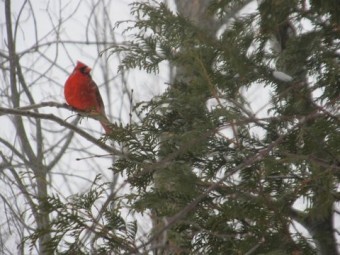
Northern Cardinal on the Hibou trail (Photo by John Dickson)
On February 8, despite some challenging weather conditions, we once again had a full house in attendance for a presentation by club favourites, Willy Waterton and Audrey Armstrong. Entitled Northwest Passage – in Franklin’s Wake, an illustrated talk about their travels from Cambridge Bay to Iqaluit, it featured Willy’s photographic images, and Audrey’s own artwork. Their talk also highlighted the involvement of Group of Seven painters A.Y. Jackson and Lawren Harris, and a local connection to the search for remnants of John Franklin’s expedition. I especially enjoyed learning how Willy had made an extra effort to have some “alone” moments to try to soak up some of the serenity and power of this vast northern area, and to get some photographic documentation from different angles and perspectives. Audrey also shared her hands-on approach to capturing images of the spectacular scenery. She settles down and then, with her own powers of observation, and skills as a visual artist, renders those images with her paints and brushes.
The Northwest Passage (Photo by Willy Waterton)
On February 12th the NeighbourWoods North (NWN) committee of OSFN, adopted this mission statement –
NeighbourWoods North organizes naturalization and tree-planting projects with volunteers in the Owen Sound area to create environmental benefits, enhance the attractiveness of the community and contribute to local quality of life.
NWN Committee Chair Lloyd Lewis reports that,
This spring NeighbourWoods North intends to plant several thousand trees on the Grey Bruce Regional Health Services grounds. We will be looking for volunteers to help with this planting soon; so please keep your ears to the ground.
As we go forward, we will be considering other project initiatives such as school grounds plantings and greening the mouth of the Pottawatomi River. Financial donations are eligible for tax receipts and help us carry out our mandate. They can be directed through the OSFN.
On Family Day OSFN responded to an invitation from Grey Roots to provide some snowshoes and guidance to visitors there, especially for youngsters. Although the traffic was light at first, towards the end of the afternoon, it was a popular activity indeed. In scouting out the property at Grey Roots, I discovered several wildlife species including Woodpeckers, Mourning Doves, Nuthatches, some rabbit tracks, and many varieties of trees to test visitors’ identification skills. Many thanks to OSFN Director Elaine Van Den Kieboom for her extra efforts and to Grey Sauble Conservation for providing the snowshoes.
On February 24th members of the Young Naturalist Club received some first-hand tutelage in the art of tracking from Jeff Kinchen, whose innate knowledge of Nature, derived from patient observation and study, is freely shared on these popular hikes. Young Naturalists Coordinator Elaine Van Den Kieboom included in her report –
Our latest meeting on February 24, 2018 had the Young Nat’s being led by Naturalist Jeff Kinchen down the field and into the bush on his family property near Bognor. Even though we had experienced a significant loss in the amount of snow, there were still numerous tracks and sign of various animals to see. We were also fortunate to see a young porcupine resting up in a tree.
It was a beautiful day weather wise. Jeff’s knowledge and experience as a wildlife tracker and his enthusiasm for sharing his knowledge with children, combined with a sunny day, made for a great hike. I would like to extend my Thanks to Jeff and his family for making it a great day for the kids.
Jeff demonstrating a deer’s walking pattern. (Photo by B. Robin)
OSFN members will once again be able to witness and learn from Jeff Kinchen this Saturday, March 3rd.
Entitled Who Made Those Tracks and Why? An Interpretive Late winter tracking Hike. With Jeff Kinchen, one can learn to recognize some of the particular characteristics and distinctive impressions evident in the snow and/or mud, on tree trunks, or other vegetation, and near waterways. This has become one of the most popular of our annual club field trips.
OSFN’s next Indoor Meeting, entitled Belugas ’Qilalugaq’ in the Arctic, is at 7PM March 8, in the Owen Sound and North Grey Union Public Library, featuring Dr. Sonja Ostertag. Dr. Ostertag is a research scientist who attended elementary and secondary school in Owen Sound, and was drawn, even then, to environmental science. She continued her studies at McGill, and then completed her PhD at University of Northern B.C. in Prince George. She then began her post-doctoral fellowship, conducting research on beluga whales, with the Department of Fisheries and Oceans.
Dr. Sonja Ostertag
According to Dr. Ostertag, the annual migration of beluga whales, called qilalugaq in Inuvialuktun, presents an important opportunity for subsistence harvesting by the Inuvialuit of the western Canadian Arctic, and for collaborative study on how environmental change may impact this species, plus unique insight for research and co-management.
Having received some encouragement for recommending a few books in last month’s column, I will suggest these titles to enjoy and as a source of learning from their nature components.
Full Curl, by Dave Butler, published by Dundurn Press. This first novel by a career biologist, framed as a mystery and loosely inspired by real cases, presents a Park Warden’s attempts to solve wildlife poaching crimes, in Alberta and British Columbia. The challenges and the accomplishments involve politics, the need to share information between wildlife agencies, and teamwork. The author’s knowledge and love for nature is evident in the evocative imagery portrayed frequently throughout. For me the most satisfaction came from looking up in nature books, or online, the many species with which I was unfamiliar, including these few examples – Engelmann Spruce, Kinnickinnick, and a mountain ecotype of the Woodland Caribou, plus American author and environmental activist Edward Abbey.
Lightfoot, by Nicholas Jennings, published by Penquin. Most of us are familiar with this iconic composer and story teller, who has created an immense catalog of familiar tunes and lyrics. This book will also introduce to you Gordon Lightfoot the naturalist who, when his personal and professional lives were almost too much to handle, found solace and rejuvenation in nature, spending the month of August for many years, paddling the rivers of Canada. References to ” the green dark forest”, “Pussy Willows, Cat-tails, Soft Winds and Roses”, “Where the road runs down by the Butternut grove” all point to Lightfoot’s familiarity with the natural world where he grew up in Southern Ontario, sailing on Georgian Bay, and being surrounded by the rocks, trees, rivers and lakes of the Muskoka cottage country.
In the Footsteps of Grey Owl, Journey into the Ancient Forest by Gary and Joanie McGuffin, published by McLelland and Stewart. I have only recently discovered this beautiful book which documents the retracing of Grey Owl’s journeys via canoe and portage. Both the writing, by Joanie McGuffin, and the images from her husband Gary’s photographs are first-rate, and along with the story-telling and the pictures, you will also be able to learn about the various trees, insects, birds, and mammals that add to the diversity of parts of our northern lands. The McGuffins also document some of the changes to river watersheds with the installation of dams for hydro-electric power. Interspersed through the pages are excerpts from Grey Owl’s own distinctive writings, and although I read most of his works a few years ago, this book, In the Footsteps of Grey Owl, makes a nice refresher, and reminds us of the importance of saving at least some of the land’s natural integrity for the purposes of having a healthy wildlife population and for healthy recreation for humans too.
Just a reminder that tickets for the Earth Day keynote address by acclaimed author, archaeologist, explorer and naturalist Adam Shoalts, known as Canada’s Indiana Jones, are selling quickly now. Celebrate Earth Day at 2PM , Sunday April 22, on board the MS Chi Cheemaun. Advance purchase is recommended as seating is limited. Tickets are only $5., and are available at OSFN Club meetings, at the Ginger Press, OS Farmers Market and the Springmount Office of Owen Sound Transportation Company. Sponsored by Caframo, all proceeds go to OSFN Youth Projects.
Lately (if your membership is paid up!) you may have noticed that you’re getting frequent “e Herald” messages with notices about events with two of our sister organizations, Saugeen Nature and Bruce Trail. We’re sharing information and events to deepen potential experiences for all of us. This is a welcome addition to our own programs. Expand your horizons and participate with these groups!
Too often the many people who work behind the scenes in organizations such as ours are doing some great work but get little, if any, recognition for their contributions. Every year about this time we turn our gaze on some of these individuals with a sharper focus: award season is here! There are several types of awards, some through OSFN and some through OnNature. Look for the list later in this newsletter and on our website. Please consider nominating someone who you think deserves special acknowledgement. Send me an email mudtown2@gmail.com or text 519 538 1897.
As you read this edition of the Hart’s Tongue Herald, realize that it is Norah Toth, our editor, who puts it all together for you to read. If you like the newsletter please tell her so!
You are likely aware that recruitment for new directors to the OSFN Board is underway. Election will occur at our AGM and potluck supper in June. Already there are several members expressing interest in standing for nomination, to which I say YAY! It’s so rewarding to have a strong team. Their diverse talents and various areas of interest and levels of experience make it a lot of fun while working to accomplish the goals of the OSFN.
At our indoor meetings we have a Suggestion Box on the sharing table; don’t hesitate to drop something in. We’re already following up on some great ideas!
The next Young Field Naturalists’ event, a tracking outing with Jeff Kinchen, will be on Saturday February 24th from 2-4pm. Details on the revised schedule or at the Young Naturalists’ Page. Slightly melted tracks. (Photo by Brian Robin)
Bannock
At the January outing, the kids (and adults!) cooked bannock over an open fire. It was my first time partaking, and I’m pleased to be able to share this recipe. Mine lit on fire, which I’m told is the traditional method of ensuring doneness, and it was delicious. ~Brian
Mmmmmmm. (Photo by Brian)
Krista’s Campfire Bannock
3 cups of flour
2 tsp baking powder
2 tsp salt
1/3 cup sugar
(optional 1 tsp cinnamon)
1/2 cup of margarine
Cut in margarine into the dry mixture until margarine is about the size of a pea. Slowly add water until it is the right consistency to roll into balls. (about 1 and 1/4 cup of water – give or take). Roll the balls in a little bit of flour to reduce stickiness.
This recipe provides enough bannock for about 25 children.
Peter Middleton will be speaking at the Grey County Gardeners Club, Tuesday, March 27th, 2018. Always informative and inspirational, Peter will be talking about some of Canada’s national parks and reserves.
A version of this column appeared in the OS Sun Times on Friday, February, 2, 2018.
< hr>
On January 11th, Peter Middleton presented Ancient Plants of Grey and Bruce, sharing fascinating details of many of the ferns to be found locally, some of which are considered among the earliest lifeforms of our world. Peter, a respected ornithologist, remarked that the late Nels Maher had inspired him to learn more about the richly diverse fern population in our region. Sharing that knowledge with club members through field trips and this presentation, is Peter’s way of honouring that rich legacy for which Nels is fondly remembered.
Peter explaining the characteristics of a bracken fern (Photo by Brian Robin).
One of the regular features at OSFN meetings is called “Sightings”, an invitation to those in attendance to share some of their recent nature observations. At this meeting several OSFN members mentioned seeing flying squirrels, and one observer was surprised to see the footprints of a bear, in his own snowshoe tracks when he had re-traced his steps from a few days earlier.
On January 20th Bob Knapp led a combined OSFN and Bruce Trail snowshoe hike on the Clearview/Pines Side Trails, where a distinct isolated valley, along with wetland, streams, old tree specimens, and signs of early settlers’ habitation were noted. There was plenty of evidence showing the previous high water run-off and freezing that had taken place along the creekbed there, along with tracks of wildlife who also like to use the Bruce Trail on their own. A special highlight for fellow hiker Peter Harris and I was to catch a fleeting glimpse of a large snowshoe hare some distance away. For some in attendance it was also an opportunity to visit the nearby historic Polish Tree, an American Beech tree, with Polish language carving including some of that country’s national anthem, inscribed a by a Polish soldier training here in 1942. A special thank you to Bob who is always eager to get people out to see the wonder of nature we have in the area.
Photo By Bob KnappPhoto By Bob Knapp
Twice during the following week, he and I skied in the area southwest of Kemble Mountain, and were treated to a rare sighting of the elusive Barred Owl.
Photo By Bob Knapp
On January 28 the Young Naturalist Club had its annual winter visit to the Bognor Marsh, to snowshoe/hike on the trails there, see some animal tracks, and other winter nature highlights, and finish off with cooking their own delicious bannock over an open fire, and sipping their hot chocolate. It was very intriguing to see how one keen youngster latched on to Club member Bill Moses, for a little while, getting her own special tutorial about nature highlights at this popular location.
Bill and a Young Naturalist (Photo by Brian)
Special thanks to Coordinator Elaine van den Kieboom for organizing this popular outing. OSFN President Kate McLaren reported –
“On a hike that took us along Bognor Marsh shore, through mixed forest and across meadows our group encountered every kind of slippery footing possible! Ice, wet snow, mud, trickling stream, packed snow, frozen earth – you name it. Snowshoes were useful in some places and a hindrance in others, but we all made it safely back to the bonfire and bannock.
Bannock! It’s done when it’s on fire. (Photo by Brian)
Along the way we watched for signs of creatures, mainly checking for tracks and deposits of scat. There was one puzzling pile of scat that baffled us all. The prints of deer were abundant. Coyotes had been out some days earlier, leading to the comparison of feline tracks vs canine: if claws are evident it’s very likely canine (coyote, dog, wolf) as feline species (cats, foxes, lynx, bobcat, cougar) retract their claws unless they’re actively using them.
Rabbit, squirrel and mouse trails were evident and there was a long discussion about unusually elongated pellets suspected of being a sign of ruffed grouse. Further research is needed to make a positive identification.
Deer tracks (Photo by Michelle Parkin)
As well there was an investigation of galls on remnants of goldenrod, the woody bandaid the plant creates around the invading insect. Seeds still attached to the fluff from milkweed were scattered across the snow awaiting spring to sprout new life.
Although a few chickadees were observed, and ravens were heard, most birds were laying low that afternoon but their signs were obvious. They had distributed the remains of cedar seeds after consuming the nutritious portion. Part of a nest had fallen to the ground causing us to ponder who the maker might have been.
We saw a great variety of trees and shrubs, identifying them through their different sizes, shapes, textures and patterns. Former pasture has been reforested a decade or so ago with partial success, making pleasant small groves of conifers in the otherwise sunny meadow.
With 28 people on the trail any wildlife in the neighborhood was in hiding!”
On February 4th, OSFN members are invited to join Carol Harris and the Friends of Hibou for a snowshoe hike on the inner trails at the Hibou Conservation Area.
On Thursday February 8, at 7PM, Willy Waterton and Audrey Armstrong will present Northwest Passage – in Franklin’s Wake, an illustrated talk about their travels from Cambridge Bay to Iqaluit. Come and learn about a local connection to the search for Franklin. Willy and Audrey have a reputation for providing an engaging and comprehensive exposition of their journeys.
OSFN meetings are held in the auditorium of the Public Library in Owen Sound. Admission is free, although donations are welcome. Memberships can also be purchased and/or renewed, and tickets for the Earth Day Keynote Address, will also be available. Author, Archaelogist and Naturalist Adam Shoalts, known also as Canada’s Indiana Jones will return to Celebrate Earth Day with us at 2PM on Sunday, April 22, aboard the Chi Cheemaun. Tickets are only $5. but seating is limited so early purchase is recommended. They are also available at the Ginger Press, the Owen Sound Farmers’ Market and at the Chi Cheemaun office at Springmount. This event is, once again, generously sponsored by Caframo.
You may recall my mention of Neighbourwoods North, and Canada 150 tree planting day at Kelso Beach Park last September. Spearheaded by Lloyd Lewis, and a vibrant new component of the Owen Sound Field Naturalists, Neighbourwoods North is already making good progress in developing its team and some very exciting projects here in the city. We look forward to sharing more about these endeavours with you in future columns.
I always seem to have several books on the go, and here are a few with some kind of nature component that I have been reading lately. I have no hesitation in recommending all of them for you to enjoy while relaxing after (or before) your skiing or hockey or shovelling.
Dynamic Forest – Man versus Nature in the Boreal Forest, by Malcolm Squires, published by Dundurn Press. Squires, a retired forester, who like so many of us, was opposed to “clear cutting” as an acceptable method of silviculture, relates his own gradual conversion and now makes the case for clear cutting, to simulate the rejuvenation that happens after a forest fire, resulting in a healthier forest, while reducing the risk of fire in areas with human population. This is an eye-opener, and was recommended to me by Ted Armstrong, our scheduled speaker for June of 2018.
Birding Without Borders, by Noah Strycker, a surprisingly delightful documenting of Strycker’s quest in 2015 to see, with witnesses, the most bird species of anyone in the world in one year, so far. Strycker’s journeys and adventures with local birders in many parts of the world, are shared with engaging candour and for a book about the biggest list, it is never tedious.
Original Highways – Travelling the Great Rivers of Canada, by Roy MacGregor is a modern update on writing about Canadian rivers by Hugh MacLennan 50 years ago. Reading this book is an opportunity to learn more about the history and current status of many of these important waterways. MacGregor is one my favourite writers and this did not disappoint. It was a pleasure to meet him here last summer when he was a panelist at the Tom Thomson commemoration event at the Harmony Centre, hosted by the TOM.
A History of Canada in Ten Maps – Epic Stories of Charting a Mysterious Land, by Adam Shoalts, our speaker for Earth Day 2018. Since childhood, Shoalts has had a fascination for maps, and here he outlines the impacts of ten maps that were instrumental in documenting various parts of this vast land, and the roles those maps have played in the explorations of our predecessors. This is Shoalts’ second book, and with his study of original source documents, is an elegant and rich portrayal of aspects of Canada’s history, which just may spark a few comments like “We didn’t get these details in high school!” I would especially recommend this book to students, teachers and armchair travellers.
It was one year ago, that the Owen Sound Field Naturalists were granted charitable status for the work we do. Although we are not actively fundraising, we welcome donations and bequests, and are able to provide tax receipts for donations in support of our various activities, including our LEAF fund, for Local, Educational, and Action items, and our Lorraine Brown Conservation Fund, in support of nature reserve acquisitions, and stewardship, etc.
Details about all OSFN programmes, Young Naturalists, online membership and donations can be found at www.osfn.ca
A version of this column appeared in the OS Sun Times on Thursday January 11, 2018 .
The Owen Sound Field Naturalists presentation on December 14, featured Angie Littlefield, an engaging speaker, who enlightened the audience about the “Nature” knowledge of Tom Thomson, who, in his formative years, spent many hours on nature hikes, and in the company of prominent contemporary naturalists, some of whom had family connections for him. One of her sources, suggests that “Tom had his naturalist bent from Uncle Brodie” – (Dr. William Brodie). Also shared were examples of Thomson’s more detailed nature art, of wildflowers, and fish species, as well as some of his more iconic painted images, and even many of his photographs. Some of Thomson’s paintings also document the some of the effects of human activities – showing the devastation of forested landscapes through logging, fire and construction of dams. Littlefield’s research also led her to suggest that Thomson spent some time with Grey Owl during his trip to western Canada, and that both are included in a photo of swimmers in the Banff area in 1913. Thomson was also noted for his preparation of tasty cuisine.
Angie Littlefield (supplied photo)
The next presentation in our speaker series is at 7PM Thursday January 11, at the Public Library in Owen Sound, and features Peter Middleton with “Ancient Plants of Grey and Bruce”. Here is Peter’s outline –
“The two counties we call home are also the place where a number of remarkable plants that have occupied the earth for aeons find a place to live. From the escarpment face to the forests and fens, mosses, liverworts, ferns and trees thrive. This program will introduce a few of them and their remarkable histories.”
Peter explaining the characteristics of a bracken fern. (Photo by Brian Robin)
On January 28 the Young Naturalists will share their outing with the regular OSFN club members at Bognor Marsh for a snowshoe Nature hike. There is still room for more Young Naturalists to participate in club activities. Visit www.osfn.ca for more information.
Christmas Bird Counts
Many area naturalists participated in Christmas Bird Counts throughout the area, from December 14 to January 5. Here are some excerpts and highlights from many of them.
The 47th Annual Owen Sound Christmas Bird Count was held on Saturday, Dec. 16, 2017. 33 observers in 8 groups recorded 6286 birds of 63 species. There were several count highs this season, especially with woodpeckers. There were count highs for Red-bellied Woodpecker (16), and the second highest count for Hairy Woodpeckers (50). There were also count highs for Rock Dove (675), and Red-breasted Nuthatch (45).
Other sightings of note include:
One male Barrow’s Goldeneye, a species recorded only once before on a count in 1977.
The first Ruddy Duck ever recorded in the history of the Owen Sound CBC.
1 Broad-winged Hawk, previously only recorded on the count in 2006 (referenced on the Audubon CBC website for the Owen Sound area).
1 American Coot, a bird not recorded every year on the count and always in small numbers.
3 Brown-headed Cowbird, a bird not recorded in the count since 2002, and a Common Grackle, not recorded since 2012.
Other unusual birds recorded this season include 1 Tundra Swan, 4 Eastern Bluebird, 1 Northern Flicker, 2 Merlin, and a Snowy Owl.
The lack of certain winter finches was notable, with no Purple Finch, Common Redpoll, and only one Pine Siskin this season.
Compiler – Erik Van Den Kieboom
The 42nd annual Hanover-Walkerton Christmas Bird Count also took place on Dec. 16, 2017 with 28 participants searching woodlots, open fields and feeders in search of their feathered friends.
By the end of the day 49 species had been recorded totalling 6375 birds with an additional 3 species being recorded during the count week period. One new species was recorded when 2 Ring Neck Ducks were observed at Chesley, bringing the overall total species seen to a impressive 105 over the 42 years. 4 species would set new record highs they were Great Black-backed Gull 11, Blue Jay 307, Bald Eagle 30 (23 were observed in one field alone), and Golden Eagle 2.
Compiler – Gerard McNaughton
Neyaashiinigmiing (Cape Croker) CBC
The seventh annual Neyaashiinigmiing (Cape Croker) Christmas Bird Count was held on Saturday, December 16.
Eighteen participants eked out a record low total of 35 species.
However, two new species for the count were seen – Lesser Scaup (1) and American Coot (1), raising the composite seven-year total to 77. A count-week Ring-necked Pheasant was also new for the list. All-time high counts were tallied for Canada Goose (3, previous 2), Hairy Woodpecker (8, previous 7) and Northern Cardinal (13, previous 12).
Compiler – Jarmo Jalava
Wiarton CBC
The 44th Wiarton Christmas Bird Count was held on Sunday, December 17.
Twenty-four participants and three feeder watchers tallied 50 species (close to the 44-year average of 48.4, and the 10-year average 50.5) and 3,818 individuals (44-year average 3,405, 10-year average 4,135).
All-time highs were tallied for Cooper’s Hawk (3, previous 2), Pileated Woodpecker (12, previous 6), Blue Jay (445, previous 385) and Dark-eyed Junco (70, previous 58). No regularly occurring species had record low counts, but numbers of dabbling ducks, European Starling, House Sparrow and winter finches were well below average.
Compiler – Jarmo Jalava
The 47th annual Meaford CBC was held on Thursday December 28 under cold, but windless conditions.
55 species were tallied; up from the last-20 year average of 49.7 and reflecting the continuing trend towards higher species counts over the more recent years of this CBC. 55 species is the third highest total in 25 years; 4th highest in all 47 years. Total individuals was 3817, slightly lower than average. No new species were found, leaving the cumulative count total at 120.
Winter finches included 12 Purples, 2 White-winged Crossbills and 16 Common Redpolls. House Finch (including one male counted in the bill of a Northern Shrike!) were back to a low count of 10, after recent better years. Bald Eagle was missed for the first time in 5 years. 2 Golden Eagle confirmed their continuing trend of overwintering in the area. Cooper’s Hawk was absent for the first time in 10 years. Two days after the count Mark Wiercinski called in 3 Eastern Bluebird going in & out of a nest box. Great birds for Count Week! Bluebirds have been recorded on 3 previous counts in 47 years. They’re hardier than they look!
Compiler – Lynne Richardson
House Finch and Northern Shrike (Photo by Ethan Gosnell)
Results Of the 2017 Kincardine Christmas Bird Count (KCBC) on Friday December 15th. The first ever Baltimore Oriole seen brought the historic 33 year total to 121 species. The Oriole was an anticipated find for it had been eating peanuts at a feeder on the south side of Kincardine for a week prior. Many people are familiar with the Oriole’s beautiful song and orange color during our summer months. Orioles along with most song birds migrate south but on occasion stragglers get left behind.
Here are the complete 2017 Kincardine Christmas Bird Count results. Twenty-two participants counted 2366 individual birds of 51 species. Goldfinch and Juncos were found in greater than usual numbers. Baltimore Oriole was new to the count.
Compiler – James Turland
Subject: Pike Bay and Cape Chin CBC’s – Dec. 29th and 30th, 2017
These two CBC’s cover the central Bruce Peninsula and provide a great snapshot of winter birds present on the peninsula this time of year.
This was the second year the Cape Chin count has been held and Pike Bay just graduated from year 4.
Pike Bay CBC Dec. 29th (known for having Canada’s first Eurasian Tree Sparrow on a CBC!!!)
37 species; 1607 individuals.
Cape Chin CBC Dec. 30th (one of the newest CBC’s in Ontario, with some of the highest verticals – Cabot Head!)
31 species; 907 individuals.
New species for count: Common Grackle (feeder bird)
Winter Finches (combined counts):
Common Redpoll (172)
Pine Siskin (101) – scarce but 1 flock of 100
Highs:
Golden-crowned Kinglet – 29 and 8. Quite high for the Pike Bay count.
Brown Creeper – just 3, but still a new high for Pike Bay CBC. They are notoriously difficult to find in winter.
Ruffed Grouse – 17 and 6. Smashes the old records. I do think it is a good year for them and that this isn’t just an anomaly.
Compiler – Andrew Keaveney
Tobermory Date: Dec 20, 2017. Participants: 40. Total Species: 41 (average=40).
Total individuals: 1108 (average=1646).
Noteworthy Highs, Lows and Misses:
Wild Turkey: 29. Record high. Wild Turkey was first detected on the Tobermory count in 2008 and the growing numbers on the Peninsula reflect an ongoing increase throughout the Great Lakes area over the past decade.
Eastern Screech-Owl: 4. Tied for the second highest count (four were also detected in 2012). In 2013, seven were recorded (average=0.7).
Red-breasted Nuthatch: 155. A record high (average=41).
Summary: Individual birds were scarce although the species total (41) was close to the 45 year average and up from last year’s tally (36)
Compiler – Michael Butler
The 14th Saugeen Shores Christmas Bird Count took place on Wednesday, January 3, 2018 with 28 people participating and 10 feeder watchers.
We found a total of 3504 individual birds; representing 49 species which is below the average of 53. No species were new to the count so the cumulative total remains at 102 species.
Of interest is an Oregon Junco which was photographed at the same feeder where one was recorded during the 2017 count. Some totals that may be interesting, are Snowy Owl (15), Brown-headed Cowbird (6, high for the count), Common Redpoll (40), American Goldfinch (733, 2nd highest for the count), House Sparrow (3, low for the count).

 Thursday night’s strong show of support for the OSFN to formally defend the habitat of piping plovers, along with conservation of dune ecology was very inspiring!