The topic of the February presentation of the Owen Sound Field Naturalists (OSFN) is:
Changing Dynamics of the Fish Community in Lake Huron, with Arunas Liskauskas, of the Ontario
Ministry of Natural Resources and Forestry. The Lake Huron aquatic ecosystem has experienced profound changes over the last few decades, primarily driven by the effects of invasive species. Fish communities have been altered and food webs have been disrupted and changed. Predicting the future state of fish communities has become much more difficult as a result.
Management biologist, Arunas Liskauskas, will provide an overview of management and research efforts aimed at trying to understand these changes.
Arunas Liskauskas has been working as a management biologist with the Upper Great Lakes Management Unit of the Ministry of Natural Resources and Forestry since 1992. He received his Hon. BSc and MSc from the University of Guelph in Fisheries Science and Fish Genetics. After working in Algonquin Park and eastern Ontario he has been involved with monitoring and assessing nearshore fish community health in Lake Huron, liaising with the public on fisheries management issues and was the lead author of the Lake Huron Environmental Objectives. This event is scheduled for 7pm this Thursday, February 8, (doors open by 6:30pm) at the Harry Lumley Bayshore Community Centre and on Zoom – with a ZOOM LINK available upon request, by emailing, in advance, to web@osfn.ca with Fish in the subject line.
Everyone is welcome, with admission Free or by Donation. For more information please visit www.osfn.ca and on Facebook.
Congratulations to Beth Gilhespy, popular OSFN speaker, hike leader and author, on her recent appointment as CEO of the Escarpment Biosphere Conservancy (EBC), who announced ‘We are so excited to announce the hiring of our new CEO – the incomparable Beth Gilhespy! Beth is a proven conservation leader, with a record that demonstrates not only her passion for the escarpment and protecting species at risk – but also the broad range of skills needed to get the job done!’ Beth Gilhespy replied ‘Soon I’ll be saying goodbye to my dear animal friends and colleagues at Toronto Zoo Wildlife Conservancy. It’s been an amazing time of learning and growing. Now back to the land, always in my heart. My last day with my amazing Zoo colleagues is March 1 (lots to do between now and then!) and I start at the Escarpment Biosphere Conservancy (EBC) March 4, 2024.Gilhespy was also on hand nearby for EBC’s afternoon of snowshoeing and hot chocolate at Mooi Nature Preserve, by the Spey River on February 3rd.
Coming soon to a backyard near you is the Great Backyard Bird Count, February 16–19, an annual four-day event that engages bird enthusiasts of all ages around the world in counting birds to create a real-time snapshot of where the birds are. Anyone can participate, from beginners to experts. You can count for as little as 15 minutes on a single day, or for as long as you like each day of the event. It’s free, fun, and easy – and it helps the birds! The Great Backyard Bird Count is a joint program of the Cornell Lab of Ornithology and Audubon with Canadian partner Birds Canada. Visit Great Backyard Bird Count to learn more and get started! For more information contact: Coordinator Kerrie Wilcox here: kwilcox AT birdscanada.org
January 31 – Cedar Waxwing Photos by Ingrid Remkins, north of Kimberley
During this past month I have enjoyed several memorable encounters with wildlife, including about 80 Cedar Waxwings observed by me on two separate occasions, when I was out for a run near Timber McArthur Park. Then when I went skiing yesterday on the Owen Sound Cross Country Ski Club’s trails at Massie Hills I heard a Pileated Woodpecker calling loudly from the parallel trail – that I didn’t take this time (!), and a little farther along I spotted a healthy porcupine nibbling on Hemlock boughs and dropping lots of ‘niblets’ to the forest floor for the others who live there too.
With all the talk of an early Spring going around, today I was noticing that the willow trees are really starting to glow in the February sunshine we are enjoying now.
Bald Eagle Feb 4 by Kiah Jasper north of Wiarton
Although the Owen Sound Young Naturalists’ did not meet in December, coordinator Amanda Eriksen offered them a birding challenge of their own and found that “they reported finding 24 species of birds in their backyards. It was really great to see those who were not all that interested in birds notice and even get a little excited about a rare sighting! I hope that this exercise has helped the kids to notice the world and the creatures around them.”
They did meet as a group again “on January 29, at the property of OSFN members Elaine and Doug Van Den Kieboom, who were wonderful hosts. Due to some perfectly timed snow, the Young Nats were able to get out snowshoeing through their forest, which starts out as hardwood then becomes cedar woods as it connects with the Bognor Marsh complex. We learned a bit about the decline of the butternut tree (of which they have only one still producing nuts and a few in different stages of illness), how the resident porcupines help keep the maples out of the cedar forest (by eating them), and how different animals like to take different trails. We also saw some tracks in the snow that we decided as a group were coyote, porcupine, and red squirrel.
Bannock! Photo by Amanda Eriksen
After our hike we came back to the house where we had a campfire with hot chocolate and cider. Elaine showed us how to cook Bannock by wrapping a piece around the end of a stick and cooking it in the coals. We now have 19 children registered and more are welcome. Our February meeting will be Crafting with Nature led by Krista McKee.” If you would like to learn more about the club and how to register someone, please email eriksenamanda@gmail.com
Fox, Feb 4th near Wiarton. Photo by Tom Ashman at RuralRootz.
And to close, here is a cute Nature quote featuring extra young naturalists, from Leon Rooke’s Swinging Through Dixie, as teacher Miss Izzard ‘the wizard, this aging mentor’ explains that her plan for the parade of pre-schoolers will include “a nature prowl, if you please, though I am aware little is to be seen save nettles, briars, animal droppings, long-leaf pine – a tickle of honeysuckle mayhaps. I shall compel them to sit on their heels, boys and girls alike, in a study of bug life. They will execute artistic creations in these drawing pads… They have given me, in the past, excellent bug renderings.”
The Owen Sound Field Naturalists (OSFN) will kick off their 35th year of operation with two January speaker events, beginning with a TREE TALK by Susan McGowan, presenting “An update on the use of parasitic wasps in control of Emerald Ash Borer in Ontario.”
The Emerald Ash Borer, which was discovered in Canada in 2002, is a devastating invasive beetle which has killed tens of millions of ash trees across Canada and the United States. Susan McGowan will give an overview of the introduced biological control programme carried out in an effort to control Emerald Ash Borer in Ontario, including our own local site at the West Rocks Management Area, in Owen Sound on Grey Sauble Conservation Authority property. She will also describe the challenge of handling fragile live insects in the summer season as a field technician.
Susan McGowan has worked in forestry and forest health since 2000, and retired in 2020 from the Ontario Ministry of Natural Resources and Forestry as a Provincial Forest Health Specialist. She volunteered to continue with the release programme in 2021 in Owen Sound.
Susan McGowan – Provincial Forest Health Specialist (Retired)
This presentation will take place at OSFN’s Indoor Meeting, 7pm Thursday January 11, at the Harry Lumley Bayshore Community Centre. Attendees are encouraged to arrive closer to 6:30pm for a relaxed social time with fellow naturalists, and an opportunity to peruse the OSFN publications on hand.
Everyone is welcome and admission is free or by donation. It is planned to also offer the event on Zoom, so anyone interested in receiving a Zoom link is asked to email, in advance, to web@osfn.ca with Ash Trees in the subject line.
Pileated Woodpecker foraging for Emerald Ash Borer at Hibou January 5 Photo by Rob Wray
The second OSFN speaker event will be a TICK TALK, Lyme Disease 101, presented on Zoom only, at 7pm January 25, by Dr. Anne Uings. This important topic will address these statements: 1) Absolute numbers of ticks are increasing, 2) The percentage of ticks carrying Lyme is increasing.3) Ticks are being dispersed to new areas by mammals and migratory birds. 4) The percentage of ticks carrying serious Co-infections is increasing.
Lyme Disease is a bacterial infection that can be transmitted by ticks. If it is not detected and treated early, Lyme Disease can cause long term illness and profound debilitation.
Anne Uings is a retired medical doctor who has been living with Lyme Disease and other tick-borne infections for 30 years. She has spent the last 20 years learning about Lyme, was a volunteer with the Canadian Lyme Disease Foundation for several years, is one of the founders of the Bay of Quinte Lyme Disease Support Group, and is a member of ILADS, which is an organization for Medical professionals involved in researching, treating and teaching about Lyme and related diseases. This presentation will be available only via Zoom, for which a link will be emailed to OSFN members, and to anyone else interested in receiving a Zoom link, who emails, in advance, to web@osfn.ca with Ticks in the subject line.
Here are selected excerpts and results from recent local Christmas Bird Counts (CBC) with notable highlights for me being the Lapland Longspurs at Pike Bay, plus Winter Wrens in that area, both of which I was lucky to spot on my own at Hibou back in November.
Tobermory CBC December 14, Compiler Tyler Miller: Total number of birds 1777, including 41 species with highest counts of Black-capped Chickadees 360, Snow Buntings 292, American Goldfinches 264, and of note, one Peregrine Falcon which is a first for the counts here.
Low counts of some species were also observed for Bufflehead (2) and Mourning Dove (0). Although Mourning Doves were spotted during the week of the Christmas Bird Count, none were spotted on the actual day of the count which is an indication that numbers in the count area is low.
Tracking trends and outliers is one of the primary goals of Christmas Bird Counts.
The highest number of Bufflehead ever counted was 121 in 2003, and it has been observed in 40 counts. This year was the 4th time a Black Scoter has been seen in this count, with the highest count of 24 also being in 2003.
Thirty-seven people participated in the count this year. It was an unusually warm day and it was very nice to be out in the park. While the north and east side of the park was sheltered and calm, it was windy on the west.
Kincardine CBC – James Turland, Compiler:
This year Kincardine conducted its 39th count on December 14. Twenty some participants equipped with binoculars and smiles scoured the count circle for our feathered kin.
A highlight for me were the many Red-throated Loons seen in feeding frenzies mixed with several other diving species such as mergansers. Red-throated Loons are smaller than the Common Loon and hold their beaks on a slight upward angle. They nest in the high Arctic and migrate through the Great Lakes on their way to and from the eastern seaboard. We seldom get to see them in their namesake breeding plumage, most birds are in a drabber winter plumage.
Five species of gulls were seen count day including the Bonaparte’s. This small gull is unique in that it nests in trees on the taiga; most gulls nest on the ground. It has a buoyant and graceful flight and eats smaller organisms than its bigger cousins. It has a black head in breeding plumage but seen here in December it only has a dark dot behind the eye. One red morph Eastern Screech Owl was found.
The 62 species found on this year’s count is the second highest ever. The 22 Cackling Geese reported was a new high. Cackling Goose is identical to the Canada Goose in plumage but is only about half the size. Also new to the count this year was a duck called the American Wigeon.
The American Wigeon is also called “baldpate” because the white stripe on its head resembles a bald man. Wigeons are common here in season but have almost all left the county by December. I am always amazed at what birds the participants can find even in December. Congratulations and thanks to all who helped out with this year’s count. If you are interested in seeing any of these birds or joining the Bruce Birding Club, contact James Turland. jaturland@gmail.com
Lone Female Red Breasted Merganser at the Bayshore. Fely Clarke, Jan. 5th.
The thirteenth annual Neyaashiinigmiing (Cape Croker) Christmas Bird Count was held on Saturday, December 16, 2023. Fourteen participants tallied a total of 39 species (average 39.5).
The 1,245 individual birds counted was slightly above the overall average of 1,027.
One of very few Snowy Owls reported in southern Ontario so far this fall was a new species for count day (there have been a few count-week records), raising the overall count total to 81 species.
Otherwise there were no big surprises, but a Common Grackle (4 rd count) was a nice find. High counts were recorded for Long-tailed Duck (54, previously 42), Red-breasted Merganser (7, previously 5), Rock Pigeon (18, previously 4), Barred Owl (4, tied previous), and Red-bellied Woodpecker (4, previously 3). Aside from a near absence of winter finches (just 2 Pine Siskins and average numbers of American Goldfinches), no expected species were missed, and there were no particularly low counts. Chi Miigwetch to Neyaashiinigmiing (Chippewas of Nawash Unceded First Nation) community, including the many folks who welcomed birders to watch their feeders, for hosting this always special birding event. And big thanks to the 14 enthusiastic volunteers! Jarmo and Miptoon, Compilers
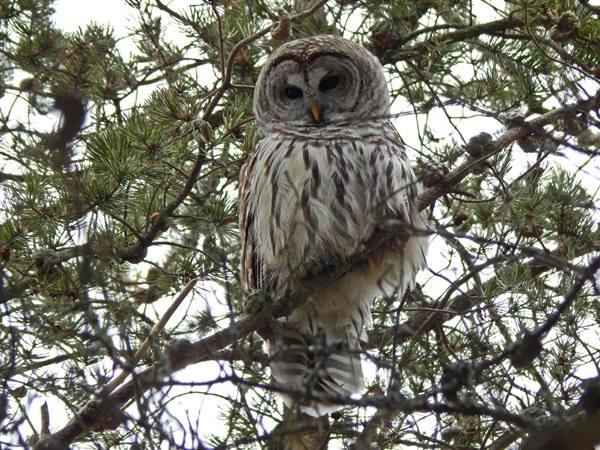
Who doesn’t love an Owl, Barred Owl. (Remember not to post locations for owls.) David Turner· December 27, 2023 ·
The 50 th Wiarton Christmas Bird Count was held on Sunday, December 17, 2023 (it was actually the 53 th anniversary of the count, but three years were missed).
Temperatures hovered between -5.7°C and 7.7°C under overcast skies all day, with light rain and drizzle in the morning and steadier light rain in the afternoon, and with moderate (20-35 kph) southerly to southeasterly winds, which were most noticeable along Lake Huron. Waters of Georgian Bay and Lake Huron were open, as were inland water bodies and watercourses.
There was no snow on the ground.
Despite the near absence of birds – and feed – at many traditionally productive feeders, twenty-five participants and one feeder watcher tallied 63 (+ 2 count week) species, tying the all-time record set in 1997. The species total was also well above the long-term and 10-year averages of 49.4 and 54.1 species, respectively.
One new species, Greater White-fronted Goose (7 individuals) was added, raising the overall species count for the Wiarton CBC to 132 (plus 6 count-week species).
The total of 8,572 individual birds smashed the previous high of 6,283, also set in 1997. This year’s total more than doubled long-term (3,431) and 10-year (4,185) averages.
Leading the pack to set this new record were record high counts of everyone’s favourites:
Canada Goose (1,988), European Starling (1,061) and American Crow (561). Tundra Swan (25), Snow Goose (3rd -ever count, 6 individuals), Mallard (365), White-winged Scoter (27), Wild Turkey (327), Northern Harrier (2), Cedar Waxwing (67) and Snow Bunting (1,343) also set new highs.
Other good finds included Green-winged Teal (3nd count, 3 individuals), a Great Blue Heron (5th count), a Cooper’s Hawk (15th count), an American Goshawk (15th count), a Belted Kingfisher (15th count), a Northern Flicker (2nd count), a Merlin (4th count), Lapland Longspur (3 rd count, 2 individuals) and a count-week Red-winged Blackbird (6th count).
No particularly low counts were noted aside from Mourning Dove (30, the lowest total since 1976).
Winter finches were limited to Pine Siskin (135, second highest total), American Goldfinch (565), and a single count week Common Redpoll.
What a wonderful, wet, dreary day of birding. Thanks to all the volunteers for your efforts!
Jarmo Jalava, Compiler
Meaford CBC December 28th:
The 53rd annual Meaford Count on Thursday December 28th with the 5th highest total – 57 species –
Three new species were added to the 53-year cumulative total for this count – Snow Goose, Trumpeter Swan and Gray Catbird. These additions bring the all-time cumulative total to 129 species.
Three new Highs were recorded – 4 Cackling Goose, an amazing 57 Horned Grebe out from Meaford, and 389 American Crows.
Eastern Bluebirds made an appearance again this year, continuing their trend of the last few years of overwintering in this area (6 of the past 7 years).
Total individuals at 6455 birds breaks the 1975 record of 6347 birds. Over 1000 each of Canda Geese and Snow Buntings contributed to this high.
It was a good count. Thanks again to everyone, and happy, birdy, New Year to all!
Lynne Richardson,
Compiler
Welcome to 2024.
The New Year at least brought a bit of colder weather to the Bruce after quite an interesting couple days of CBC weather. The two central Bruce Peninsula CBCs were enjoyed by all who attended and have once again provided a valuable snapshot of birdlife on the peninsula at a time of year when the Bruce received little coverage. I had a lot of great feedback and I trust you enjoyed your time outdoors as much as I did. I hope to see you out birding in 2024.
Given the mild December we’ve had, it probably didn’t come as a shock to many participants that waterbirds were around in both greater diversity and numbers. Grebes continued to show well and while Georgian Bay was mostly absent of diving ducks, on the Huron side the largest number were recorded on the Pike Bay count to date. Raptors were clearly scarce, and the Snowy Owls we’ve come to expect were absent for the second CBC in a row. Finches were likewise notably absent in diversity, with only American Goldfinches and Pine Siskins showing some numbers.
The Pike Bay count was held on Friday, December 29th.
Notable misses: Lapland Longspur, House Finch, Purple Finch, Snowy Owl, Red-tailed Hawk, accipiters, Common Loon
Count Week species: Cackling Goose, Gadwall, Northern Pintail, Song Sparrow, Red-winged Blackbird, Purple Finch, Lapland Longspur… adult Golden Eagle missed by 1 day!
The Cape Chin count was held on Saturday, December 30th. Conditions were similar to the Pike Bay CBC but with no rain and some brief periods of extremely light snow fall. The sun even showed itself a few times. Barred Owl has still never been recorded on this count, which is rather astounding because it is certainly resident, as owl surveys during the current Ontario Breeding Bird Atlas have shown.
New species: Canada Goose (2), Mallard (2)
Unusual species: Cooper’s Hawk and Winter Wren (both removed from ‘cw’ only), Great Horned Owl (3rd time), White-winged Scoter (1), Hooded Merganser (9), Common Merganser (8)
High counts: Horned Grebe (35), Bald Eagle (14), Eastern Screech-Owl (4), Hairy Woodpecker (31), Snow Bunting (376), American Tree Sparrow (2), Pine Siskin (18)
Low counts: Ruffed Grouse (3), Herring Gull (7)
Notable misses: Brown Creeper, Bohemian Waxwing, Purple Finch and Evening Grosbeak—the last two species scarce to absent on the peninsula this winter
Thank you again for your continued participation in this very worthy endeavour. The counts could not be possible without your individual efforts on count day and every last one of you contribute more than you know.
Happy New Year,
Andrew Keaveney
Pike Bay and Cape Chin CBC Compiler
American Robin, Owen Sound photo by William Gray January 4
The 20th Saugeen Shores CBC was held on Wednesday, January 3rd, 2024. The ~24-kilometre count circle is centered several kilometres southeast of Port Elgin and includes Southampton, Port Elgin and Pasiley townsites, as well as adjacent waterfront and MacGregor Point Provincial Park. 34 participants split up into 6 sections surveyed the count circle, which is higher than the last several years. Several feeder watchers also contributed, adding a few species missed by the rest of the count.
Overall we observed a total of 13,377 individuals of 66 species. This is the 2nd highest count of individual birds in the counts history (highest was 18,313 in 2021) and the highest ever species tally with 66 species observed (previous high was 64 in 2016). This is considerably higher than the long term average of 7,750 individuals and 53 species.
Highlights included 3 new species for the all time CBC list; Greater White-fronted Goose (2 birds), Red-throated Loon (5 birds) and Winter Wren (1 bird). Several other notable species and high counts were recorded, including; Tundra Swan (2nd count record), White-winged Scoter (3rd count record), Peregrine Falcon (2nd count record), Canada Goose (new highvount of 6,298, previous 5,058), Cackling Goose (new highcount of 7, previous 4), Long-tailed Duck (new highcount of 32, previous 11), Northern Harrier (Tied the past highcount of 2), Bald Eagle (new highcount of 57, previous 36), Iceland Gull (Tied the past highcount of 2), Golden-crowned Kinglet (new highcount of 29, previous 26), American Tree Sparrow (new highcount of 84, previous 76).
This years count was an interesting one … waterfowl and gull numbers were both very high, with several species setting record high counts. Overall numbers of raptors and passerines were average to low though, and Birdfeeders in every section were very quiet, resulting in low numbers of woodpeckers, chickadees and nuthatches. This has also been a poor winter for several northern birds like Snowy Owl and winter finches, which was reflected in our totals (missed all winter finches besides Common Redpoll and Pine Grosbeak, and missed Snowy Owl for only the 6th time in the counts history). Another interesting trend to note is the decline of the European Starling and House Sparrow, both of which seem to be showing a steady downward trend over the last 15 years.
We tried to fully eBird this Christmas Bird Count, with trip reports made for every section as well as the overall count. While this was new to many participants, it went over quiet well and should make things run smoother in subsequent years. This is a great way to view and share data and compare years, and I encourage other CBCs to follow suit (also more data for eBird!). To view the trip report, see the link below.
To close, an apropos Nature quote from my own copy of Where the Falcon Flies, by Adam Shoalts, OSFN’s speaker to a full house audience just last month. While camping along the shore of the St. Lawrence River – “I was heartened to see that the woods had many ash trees that were still healthy. The invasive beetles…have so devastated the ash forests elsewhere. In the woods where I grew up had been many fine ash trees and I had mourned their loss to the beetles ever since. Seeing them again put me in a cheerful mood – it was like meeting old friends you haven’t seen in years.”
Owen Sound & North Grey Union Public Library, Sheila Gunby’s Paper Cut Designs at Owen Sound Farmers’ Market, & Suntrail Source for Adventure in Hepworth or at OSFN Indoor Meetings.
Where the Falcon Flies: Renowned professional explorer, adventurer and best-selling author Adam Shoalts returns to Owen Sound as the featured guest speaker of the Owen Sound Field Naturalists (OSFN) at 7pm Thursday December 14. This event includes a book launch and will be held “In Person Only”, (i.e. no zoom, and no recording) at the Harry Lumley Bayshore Community Centre. A popular and entertaining speaker, Shoalts will tell us about his latest adventure and his new book Where the Falcon Flies,based on a 3,400 km solo canoe journey from Lake Erie to the Arctic. The expedition took over three months and saw Shoalts depart from Long Point and travel all the way to the Torngat Mountains and Ungava Bay. As a naturalist and historian, Adam will share the story and photos of his remarkable journey. Where the Falcon Flies, and many of Shoalts’ earlier books will be available too.
Held in the Bay Room of the Harry Lumley Bayshore Community Centre, and starting at 7pm, you are also encouraged to arrive as early as 6:30pm and perhaps browse the latest offerings (Orchids, Vascular Plant Checklist, etc.) of the OSFN Publications Committee for gifts and stocking stuffers. Everyone is welcome, and admission is free, or by donation. For more information please visit www.osfn.ca
So you like birds? Consider joining a Christmas Bird Count and participate in Citizen Science.
Once again ’tis the season for
Christmas Bird Counts (CBC), from Dec 14, 2023 to Jan 5, 2024.
Thank you to Norah Toth for sharing this local outline of CBC dates and the compilers to contact, to learn more and perhaps take part in this annual inventory. The CBCs across Grey-Bruce are listed below. Thursday, December 14, 2023 – Kincardine – James Turland –jaturland@gmail.com Thursday, December 14, 2023 – Tobermory CBC – Tyler Miller – tyler.miller@pc.gc.ca Saturday, December 16, 2023 – Owen Sound CBC – Erik Van Den Kieboom – erikkieboom@outlook.com Saturday, December 16, 2022 – Hanover/Walkerton CBC – Gerard McNaughton – gmcnaughton@wightman.ca Sunday, December 17, 2023 – Wiarton CBC – Jarmo Jalava – jvjalava@gmail.com Thursday, December 28, 2023 – Meaford CBC – Lynne Richardson – lynnerichardson@rogers.com Friday, December 29, 2023 – Pike Bay CBC – Andrew Keaveney – uofgtwitcher@gmail.com Saturday, December 30, 2023 – Cape Chin CBC – Andrew Keaveney – uofgtwitcher@gmail.com Wednesday, January 3, 2024 – Saugeen Shores CBC – Kiah Jasper – kiahjasper@gmail.com Or visit this link to find a CBC near you. https://naturecounts.ca/apps/cbc/mapviewer.jsp
On November 26, the Young Naturalists visited the Kinghurst Nature Reserve, where Amanda Eriksen “led a ‘Winter is Coming’ scavenger hunt where we looked for signs of animals getting ready for winter, some of the things the creatures may be gathering to prepare, as well as places creatures may be living. The kids were terrific searchers and had great ideas about how creatures survive winter. We were lucky enough to be able to go to the old cottage which is full of information about the property and the plants and animals you can see. The kids all signed the logbook. The highlight was pumping the old well and actually getting water! We had 8 kids out with one new family joining the club. For the month of December, there is no ‘in person’ meeting, but I am working on a backyard birding challenge.” The Young Naturalists, mainly aged 7 to 12, usually meet one Sunday afternoon each month with a variety of Nature learning activities and hopefully January’s outing will include snowshoeing with snowshoes available if needed. There are currently more spaces available, and to find out more, please email Coordinator Amanda Eriksen at eriksen.amanda@gmail.com
Photo by Marsha Courtney
Continuing with the Nature gift theme, popular local birder and photographer David Turner, is once again offering calendars of exquisite bird photography for 2024. They can be purchased at Local Colour in Flesherton, and he can be contacted at fleshertonartgallery@gmail.com or phone 519 924 3560.
Photo by David Turner Rough-Legged Hawk, Beaver Valley December 10
I have continued to enjoy nature by getting outside most days, either for a walk, a run, or a bike ride and now I have added skiing on four occasions so far this season. A highlight has certainly been a bike ride in the woods just the other day when I heard the soft whistling of about 60 Bohemian Waxwings as I watched them foraging on berries in a wooded wetland. When I eventually continued my ride, I soon heard that soft whistling again, and discovered a large flock of them in tall trees beside the Rankin River. I guess I will never know if they were, in fact, a different flock or the same one who were just ‘going my way’, but two encounters with them was certainly an amazing treat to enjoy along with a December bike ride in a sunny and mild 15 degrees Celsius! The next morning I found a colourful apple adorning a small White Ash tree, placed there by a squirrel for a future snack, while Crows, Canada Geese and a male Cardinal were all foraging nearby too, coping with the challenges and rewards of the season.
Photo by John Dickson
To close, a Nature quote from Rick Mercer’s Final Report -“I’m one of those Canadians who like winter… So when we had the first snowfall here in Toronto, I went for a walk. And with the snowflakes gently falling against the streetlights I wandered around the city for about half an hour and enjoyed the sights and sounds of thirteen fender-benders in nine languages. Yes, it was a winter wonderland…”
Well-known local astronomer and former high school teacher John Hlyaniluk will present “Galapagos” at 7pm Thursday November 9, at the Harry Lumley Bayshore Community Centre. Galapagos is one of the most exceptional environments on the planet, with its ecology, geology and scientific value. The most important theory in science, expressed in Darwin’s Origin of Species, was supported by his observations there. Hlyaniluk’s talk will focus on several areas, including the discovery of the Galapagos Islands, their geology and how that has produced the distinctive species of organisms that exist there. Especially of interest are the current efforts to maintain this unique ecosystem, which is under threat from various sources. And much to their credit, the inhabitants have made the islands accessible to tourists in a wonderful harmony of nature and conservation.
Also of note, the Maher family will be on hand to make a special memorial donation to OSFN, as outlined here by Brian Maher:
“Nels and Jean Maher loved the outdoors, in particular the wilds of Grey and Bruce.
With a family of 6 children in tow we enjoyed camping, hiking, canoeing and cross country skiing together. There is a little family joke about children being conceived on camping trips.
Mom and Dad were first members of Saugeen Field Naturalists and attended meetings in Hanover, Durham and Dornoch, often with Joe Johnson carpooling with them.
When Owen Sound started a Club they became Charter Members and later Honorary Members. They loved the club members and many activities and participated in building Boardwalks, Guiding and attending hikes, and running OSFN booths at community events. Often displaying Dad’s Fern Prints and Owl collection and selling Club books. The Publication Committee team was their favourite. The Club produced many world class nature books and as a career printer dad was deeply involved in publication of these at his business. His favourites were the Orchid and Fern Guides.
In recent years Mom continued to get calls from folks looking to buy them. So she knew they were out of print. So when I sat down to discuss her estate planning as the Executor we agreed that a donation towards the reprint would be a nice Legacy to Nels’ memory.
Jean attended her last meeting in March and Died just after her 89th Birthday in April ………..happy and active till the end.
On behalf of the Maher Family I am so pleased to donate $10,000 from Mom’s Estate for the reprinting of The Ferns Of Grey and Bruce.
Thank You.”
Jean Maher (Supplied Photo)Nels Maher (Supplied Photo)
Admission is free, with donations welcome. The evening presentation will also be available on Zoom and if interested, please request a zoom link by emailing, in advance web@osfn.ca with Galapagos in the subject line or visit www.osfn.ca During the months of November and December, the display inside the doors at the Artists Co-op at 942 2nd Avenue East (the McKay Building), will feature OSFN publications, NeighbourWoods North, promotional materials and more that director Marsha Courtney has installed there.
Congratulations once more to Bob Bowles, one of four to be inducted this past week into the Orillia Hall of Fame.
Originally from the Markdale and “Bowles Hill” area, ( I first knew him in High School there) Bob will also be OSFN’s keynote speaker to celebrate Earth Day, on the Chi Cheemaun in April 2024.
Bowles is an award-winning writer, artist, nature photographer, educator, and naturalist best known for his lifetime commitment and dedication to preserving and conserving nature and as the founder and coordinator of the Lakehead University Ontario Master Naturalist Certificate Program.
Thank you to Marsha Courtney for this report: On October 29 the Young Naturalists had an Aquatic Invertebrate lesson in Harrison Park with John Bittorf from Grey Sauble Conservation (GSCA), during which we found side swimmers, aquatic worms, caddisflies of various stages, scuds, and many more, and examined them with microscopes. Bittorf engaged the youngsters in the process by showing them the scientific steps of the process, followed by questions that were sometimes simple, and sometimes more challenging, to which they responded well.
John Bittorf of GSCA had a great hands-on set up. The kids all got to play around and we had some adults join in as well. (Photo by Marsha Courtney)
The second half of their afternoon included a successful nature hike to search for Fungi, and we found lots. Trying to keep it simple can be difficult as each one can be named differently depending on which book or app that is used. The kids had keen eyes to find them. More spaces are available in the Young Naturalists club, and to learn more please email Coordinator Amanda Eriksen at eriksen.amanda@gmail.com
We found lots of fungus. Trying to keep it simple can be difficult as each one can be named differently depending on which book or app that is used. The kids had keen eyes to find them. (Photo by Marsha Courtney)
BPBO fundraiser
The Bruce Peninsula Bird Observatory has announced a Fundraising on-line Auction, on November 21-27, and are saying “Get your Christmas list ready! There will be unusual treasures for all. We are also looking for items to auction, so if you have any treasures, please email us at bpboinfo@gmail.com Stay tuned for more details!”
I was able to sit and watch this handsome coyote forage the edge of a field for its midday meal yesterday. It was very thorough and managed to catch what appeared to be several mice in the 20 minutes or so I observed it. A privilege to see it go about its daily routine . (photo by Les Anderson 10/13/23)
Each November, I watch for and enjoy the many shades of gold displayed by Tamarack trees. Insects are still evident – we had a praying mantis here until just after the heavy snow arrived. I jogged over to check some attractive red apples just off trail recently, but when I inspected two of them I found each had a large cavity containing what looked like a house fly in one and two in the other. A wasp was foraging on the leaves of a bloomless rose bush here just a few days ago too. I also had the pleasure of seeing two Clouded Sulphurs, and a few Cabbage White Butterflies fluttering nearby on a recent bike ride in behind Hibou.
Of course, the bird migration continues with many sightings of shorebirds especially Dunlins, foraging as they pass their way through here, with many keen birders on hand to document their passing, with their eyes and their cameras too.
To close, a Nature quote from John Terpstra’s Daylighting Chedoke – Exploring Hamilton’s Hidden Creek – “We paddle to the mouth of the creek through patches of lily pads and past conclaves of cormorants perched on the dead arms of fallen trees that have washed into the marsh, then glide under a bridge for the Waterfront Trail. Almost immediately Daniel spots a black-crowned night heron, the first of several … The heron flies off upstream as we approach…. We feel bird-led, or lured. We note a beaver lodge to our right. Yes, a beaver lodge…. We keep our eyes peeled for discovery.”
A Clouded Sulphur on the rail trail near Storybook Park road this morning. Nothing special about the butterfly nor the pic, but November? November 5 photo by Rob Wray
Owen Sound Field Naturalists’ (OSFN) featured guest on October 12 will be Dr. Thorsten Arnold, who worked as an academic advisor and researcher on an important new movie which Arnold will be presenting to the Owen Sound audience: the Canadian Premiere of award-winning filmmaker John Feldman’s Regenerating Life – How to cool the planet, feed the world, and live happily ever after.
As Arnold explains: “In short, the film talks about climate landscapes from a water and ecosystem perspective, about how biology is actively modifying and self-regulating the physio-chemical aspects of climate – the difference between an urban heat dome and a cool living-landscape anti-dome, so to say, and the science is solid. ‘Regenerating Life’ takes an ecological look at the environmental crises and by challenging the prevailing climate change story, offers new, attainable solutions.
Overall, the film identifies new pathways for climate action that can be done at a community level – how to stop killing the biosphere and changing our food system toward farming in partnership with nature.
Regional greening leads to regional cooling and more water availability… even with increasing greenhouse gases.”
This presentation will especially appeal to those actively working with gardening and farming. October 12 will feature parts 1 & 2, followed by a discussion facilitated by Dr. Arnold. This OSFN special event begins at 7pm Thursday October 12, at the Harry Lumley Bayshore Community Centre. However, OSFN President Brendan Mulroy, has announced that audience members are encouraged to arrive as early as 6:30pm in order to enjoy a social time, as there is little opportunity for that later in the evening.
Admission is free or by donation for the general public and there will also be an opportunity to donate to Regenerate Grey Bruce, which along with Eat Local Grey Bruce, the National Farmers’ Union Grey, the Greenbelt Foundation and the Sustainability Project, are sponsoring the work of Dr. Thorsten Arnold that he has been doing in the community recently.
For those unable or not wishing to travel, or if you’re experiencing flu-like symptoms, this event will also be webcast: this is the ZOOM link: https://us02web.zoom.us/j/84314977160 Meeting ID: 843 1497 7160Please note that a bonus, extra OSFN event at 7pm, Thursday October 26, will focus on part 3 of the film Regenerating Life, with a discussion about its special focus on farming.
Painted Turtle sunning on a log in the Sauble River October 6. Photo by Robert Knapp
In addition, OSFN’s Young Naturalists Club (YN) is up and running, with the next event at 2 to 4pm, Sunday October 29, planned as an engaging Aquatic Invertebrate ID Workshop in Harrison Park, under the direction of Rosie Martin. There is plenty of room for more participants in the YN club, with an exciting lineup of activities planned.
The Young Naturalist Club Programme Coordinator is Amanda Eriksen who can be reached via email at eriksen.amanda@gmail.com and those aged 7 to 12 can be registered with her for monthly activities, usually on the last Sunday afternoon of the month from September to June.
Off to look for the salmon swimming upstream (photo by Marsha Courtney)
The Bruce Birding Club’s (BBC) Marilyn Ohler shared this report on their October 4 sightings:
Nineteen participants enjoyed summer-like weather for the trip led by Margaret, Carol and Norma. Highlights were many Sandhill Cranes gathering for migration, a busy flock of Bluebirds along Elsinore Road and singing Eastern Meadowlarks. We saw a Monarch butterfly still here and noted that many blackbirds are still migrating, including a group or two of Rusty Blackbirds.
You can also see Marilyn’s report by following the link to ebird.
October 3 one of the Wood Ducks at Skinner’s MarshBald Eagle – photo by Ingrid Remkins October 2, north of Kimberley
The NeighbourWoods North Team has been very busy, and t
hey have two more Autumn Tree Care sessions planned from 10 to 11:30 on Saturdays October 14, and 21, at the Hospital site in Owen Sound. I have enjoyed many wildflowers and wild flyers in the meadows and pollinator gardens there when I jog along the Healing Path which now has more people using the trail system regularly too. New volunteers are welcome, but should have gloves to wear. Up to date info is available at their Facebook page under NWN.
Stephane Menu of the Bruce Peninsula Bird Observatory (BPBO) included these details in his recent blog: ‘As forecast, the weather this past week was unseasonably warm, very warm. Days alternated between being very quiet or relatively busy at the nets. Golden-crowned Kinglets have started to move in good numbers through Cabot Head and are now the most abundant bird being banded on any given day: 30 Golden-crowned Kinglets banded on September 30 and 48 on October 3, for example. On that last day, we banded a total of 78 birds of 17 species, which is the highest number of birds banded in a day for the season so far. The distant second and third species were Dark-eyed Junco (six birds banded) and Common Yellowthroat (five birds). We also captured the first Fox Sparrow of the season, as well as the first Yellow-bellied Sapsucker. The young male Pileated Woodpecker may claim the title of best bird captured for that day though, despite its ear-piercing calls.’
For more information on their work, please visit www.bpbo.ca
A Boxelder beetle, taken in August while crawling around my front garden, much to the bemusement (or perhaps bewilderment) of my neighbours. Photo by Rob Wray
I believe that 2023 has become what I learned from botanist and author John Riley, is called a ‘mast year.’ Not only are the wild grapes and apple trees loaded with fruit, but I have seen and heard Beech nuts and Black Walnuts when they fell near me, either in the woods, or in a City Park, when a chattering squirrel dropped some walnuts with a loud crash quite near me as I was pedalling nearby. A good friend has reported a bumper crop of butternuts this year too. I am hopeful that the mountain ash tree next door will keep its fruit this winter for a change, for the Cedar and Bohemian Waxwings who may visit it this winter.
To close, a Nature quote from A Long Petal of the Sea by Isabel Allende: They rode through the magnificent scenery of cold forests, age-old trees, mountains and water: water everywhere, flowing down in hidden streams among ancient trunks…It was all the dazzling and secretive work of nature…
The Owen Sound Field Naturalists (OSFN) welcome back popular speaker, hike leader and now an author Beth Gihespy, who will feature the Geology of the Niagara Escarpment in the Beaver Valley and Sydenham Club sections, as she explains both areas in connection to her Walking Through Time books. Her Beaver Valley book was published recently and will be available at the talk, entitled Building Sydenham: The Making of Walking Through Time. The Sydenham book is in the works and is expected to be published in a few months.
Gilhespy’s presentation is set to take place as part of the OSFN Indoor Meeting at 7pm Thursday September 14, at the Harry Lumley Bayshore Community Centre. Everyone is welcome and admission is free, or by donation. In addition, OSFN plans to offer the talk virtually via Zoom. Anyone interested in this version may request a zoom link in advance, by emailing web@osfn.ca with Rocks in the subject line.
Gilhespy will also be leading a hike for the club, on September 24 in the Kemble area.
OSFN is pleased to announce that the club was able to sponsor two members of last season’s Young Naturalist Club to attend this summer’s Nature Camp featured by Camp Kawartha.
The Young Naturalists are getting ready for another year! too. The Young Naturalist Club Programme Coordinator is Amanda Eriksen who can be reached via email eriksen.amanda@gmail.com and those aged 7 to 12 can be registered with her for monthly activities, usually on the last Sunday afternoon of the month from September to June. In addition, OSFN will be sponsoring four local high school students to the Ontario Nature Youth Summit at Lake Couchiching September 22-24. OSFN has sponsored many students in the past decade, and has received excellent feedback from those who have attended the Youth Summits.To learn more about
the Young Naturalist Club, about joining and/or supporting OSFN, with its many indoor and outdoor presentations, and its motto, Knowing Nature Better, please visit www.osfn.ca
I believe this is a Ruby meadowhawk but will defer to those more knowledgeable about dragonflies. Taken on the badlands while birding. (Shallow Lake) (Photo by Rob Wray)
The Sustainability Project has announced that there is a Miyawaki “Tiny” Forest Media Unveiling at Peninsula Shores District School in Wiarton on Monday, September 18, 9:30- 10:30am at
115 George St, Wiarton, with light snacks available.
Beth Anne Currie shares the following information:
Hello hard-working friends and living-landscape supporters; see the unveiling of a fast-growing Miyawaki (Tiny) Forest with a connected BIOSWALE which have been installed on Peninsula Shores District School grounds in Wiarton. a project that the Sustainability Project via Regenerate Grey Bruce, has been supporting over the past several months. These two inter-connected living systems will act as demonstration projects to showcase how living landscapes provide countless ecosystem services compared to treeless, lawn spaces.
It’s time for the official ceremony, where funders, growers, planters, water-er’s, students, teachers, parents and countless volunteers can be recognized and celebrated….. We have made a short documentary about the project – where you can see and hear a bit more background on the project.
Bring your friends, neighbours and families. Hope to see you there!
Beth Anne
Song Sparrow is a good provider for the then nesting chicks a month ago. The young ones have since fledged and I can hear them chirping to their parents from the cedar hedge. Sept. 11. (photo by Carol L. Edwards-Harrison)
The Bruce Peninsula Bird Observatory (BPBO) will host a Fall Open House, with everyone invited Saturday, September 23, from 10:00 a.m. to 4 p.m. in Tobermory, at the Bruce Peninsula National Park Visitor Centre.
Come and join us at the Bruce Peninsula National Park visitor center, in Tobermory. We will be there all day with all kinds of activities and information. You can learn all about the BPBO, and there will be Fall bird walks, display and information, plus audio/visual presentations.
For more information please visit www.bpbo.ca where you can also get an update on the recent bird migration activity with Station Scientist Stéphane Menu’s weekly blogs. Here is an excerpt from his latest –
There’s a saying that ‘a bird in the hand is better than two in the bush’. a young Red-eyed Vireo was captured for the first time on August 31… Four days later, on September 4, the same bird was recaptured. In this short span of time, it increased its weight by 23.5%, a remarkable physiological feast and a sure proof that this bird is getting ready for the long and sustained effort of migration. Fat is the preferred fuel for migrating birds, providing more energy per unit than proteins or carbohydrates. It’s energy they need in order to fly 10 or 12 hours non-stop at night, over a series of multiple flights to reach their final winter destination.
With its bountiful energy stores (and a good measure of luck!), our young Red-eyed Vireo will fly all the way to the Amazon in Brazil, with no assistance from its parents, guided by an internal compass and clock. Unfortunately, this bird – along with all long-distance migrants – will encounter many dangers on its way: bad weather, lack of food at stopover sites, predators like Sharp-shinned Hawks or feral/outdoor cats, collisions with windows, disorientation from artificial lights of ever-expanding cities, etc. It’s hard not to wish them luck as they embark on this, at times treacherous, journey.
Female Common Merganser, Lake Eugenia. Sept. 10. (Photo by David Turner)
In the past year I have been aware of the Centre for Bee Ecology, Evolution and Conservation at York University. (BEEC) and some of their many programme offerings. Here is a link to their website https://www.yorku.ca/bees/ and the opening of their most recent message to me, with a link to their very interesting newsletter and their upcoming conference with a keynote speaker, all of which you can register for. I am looking forward to looking in on more of their activities too. Our September 2023 BEEc Newsletter – Global Edition. A reminder that BeeCon registration is only open until Sept 29 so don’t delay in signing up to attend this hybrid event Oct 12-13 – it’s free! (click here for more information, including a schedule).
I have been pleased to finally see some Orange Jewelweed on Saturday’s OSFN hike throught the Amabel Tract with Kevin Predon, and just yesterday I noticed a patch of the yellow variety, while running nearby trails. Another favourite visual at this time of year is the Jerusalem Artichoke with it sunshiny flowers waving in the breezes.
September 9, Amabel Tract, Sauble Beach – Red-spotted newt in its eft form or stage (photo by photo by John Dickson)
To close, a Nature Quote from A Bend in the Road, by Nicholas Sparks: “The moon cast its glow over the slow-moving water like a walkway of reflected light. With low-slung oak trees and the whitewashed trunks of cypress trees lining the banks, the view was soothing, ageless in beauty. The draping veils of Spanish moss only added to the feeling that this part of the world hadn’t changed in the last thousand years.”
July, 7:00 am or so, southwest of Bognor, on the edge of a wetland area and out they popped. (PHOTO BY ROB WRAY)
The Owen Sound Field Naturalists (OSFN) are preparing for their 35th season with a diverse array of speaker presentations and many field trips throughout the area. Much of the new season, including events in September, will be posted at www.osfn.ca over the next week or so. To ensure you receive up to date information from the club, it is recommended that you purchase or renew your membership online.
Of note, on September 9, Bruce County Forester Kevin Predon will be leading a Bruce County Hike at the Amabel Tract in Sauble Beach, on trails from Rankin Bridge Road through both County and Crown forests, adjacent to the “Hell Hole” Provincially Significant Wetland complex, the Sauble River, and into some spectacular hardwood and conifer forests.
Then, at 7pm September 14 at the Harry Lumley Bayshore Community Centre, popular speaker, hike leader and author Beth Gilhespy will present Building Sydenham: the Making of “Walking through Time.” Beth will discuss how she approached her Beaver Valley and Sydenham geology books. These sections of the Bruce Trail have lots of great geology to discuss. Her Beaver Valley book will be available for purchase and signing.
In addition, OSFN hopes to once again sponsor two local high school students to attend the Ontario Nature Youth Summit at Lake Couchiching September 22-24. OSFN has sponsored many students in recent years, and has received excellent feedback from those who have attended the Youth Summits.
The weekend is designed and situated to provide learning opportunities in an exciting and motivational setting with 90 fellow high school students, all with an interest in Nature studies. Potential candidates should email John Dickson at jwdickso@gmail.com no later than August 30, indicating their interest and availability to attend, as the registration deadline is September 5. For more information please visit https://ontarionature.org/events/youth-summit/
One of a group of Cape May warblers that have been feeding in my birch trees for the last few days. They are heading south from their northern Ontario breeding grounds. Allenford 8/21/23, Photo by Les Anderson
The Escarpment Biosphere Conservancy (EBC) is hosting a Monarch Butterfly Festival at Alvar Bay and at Bruce Peninsula National Park’s Visitors Centre on August 25th and 26th.
Experience two days filled with nature hikes, monarch tagging and release activities, captivating butterfly documentaries, and thrilling evening bat walks. Explore the beauty of Alvar Bay, learn about the vital work of EBC, and get your hands on free milkweed seeds to support Monarch conservation. Don’t miss out on the opportunity to learn about and celebrate the wonders of nature and the extraordinary journeys of Monarch butterflies!
Monarch tagging and release activities that play a crucial role in monitoring their population and understanding their migratory patterns. By participating in tagging and release, you contribute to important research efforts and help protect these magnificent butterflies for future generations to enjoy.
In addition to the Monarch festivities, EBC will also be celebrating International Bat Day on the 26th with evening evening bat walks (Friday and Saturday at 8pm). Discover the fascinating world of bats and their vital role in maintaining our ecosystem’s balance.
All activities for this Monarch Butterfly Festival are free.
Steve Irvine August 21 After the rain; a mushroom growing in a hollow maple trunk.
James Turland of the Bruce Birding Club (BBC) has much of its fall season lineup organized, with several different leaders helping out.
The BBC is a group of avid bird watchers based in Southampton, Bruce County, Ontario Canada. The club also includes many members from Grey County, and meets on the first and third Wednesdays of the month except during the summer. The outings are most often in Bruce County but several excursions each year take the group farther afield.
Another native wildflower in my garden, the Cardinal Flower and another hummingbird using those tiny toes to hang on.
Still with ornithology, Stéphane Menu, Station Scientist at the Bruce Peninsula Bird Observatory, along with his crew, have now returned to Cabot Head for a new season of migration monitoring, from August 15 to October 31; 78 consecutive days. During this first week, most birds that were caught, banded and documented were Red-eyed vireos and 11 species of warblers. In addition, there were observations of a Bald Eagle pair with an eaglet on the nest, a young Peregrine Falcon, a young Cooper’s Hawk, a Great Horned Owl after a successful hunt and a Common Nighthawk. For more information please visit www.bpbo.ca
Great Horned Owl, in Georgian Bluffs – Photo by Rob Wray ~ August 14A Green Heron perching atop a snag near Woodford. Mid -August
Photo by Rob Wray
At this time of year I especially enjoy seeing the blooming Goldenrod and other wildflowers all aglow, waving in the summer breezes, and the Staghorn Sumac fronds, comprised of tiny individual flowers that glisten in the morning sunshine.
Another late summer treat I discovered back in 1992, while I was cycling along a road allowance in Sydenham Township, is to be accompanied by a flock of American Goldfinches, as they fly along with me, escorting me through their territory. A year ago, a dozen or more Monarch Butterflies performed a similar dance, fluttering along close by me in the morning sunshine, northeast of Kemble.
Then, just this past week, I was delighted to be led by a family of Eastern Kingbirds, guiding me as they flew along from fence post to wire to roadside bushes, during a couple of sunrise bike rides, while I was still cycling within the City of Owen Sound.
Really enjoying the Baird’s Sandpipers this year. I think there was only one last year and it didn’t stay very long. Shallow Lake this morning.
by William Gray August 22Red-headed Woodpecker, near Annan August 22 by William Gray
To close, a Nature quote from Verlyn Klinkenborg’s More Scenes from the Rural Life: “The grace of wildness changes somehow when it becomes familiar. When I say the grace of wildness, what I mean is its autonomy, its self-possession, the fact that it has nothing to do with us. The grace is in the separation, the distance, the sense of a self-sustaining way of life.”
At the Annual General Meeting of the Owen Sound Field Naturalists (OSFN) on June 8, President Brendan Mulroy presented the club’s Community Conservation Award (CCA) to Lynne Richardson in recognition of her 18 years as OSFN Secretary; her many birding field trips led for OSFN and the Bruce Birding Club; her volunteering as Compiler for the Meaford area Christmas Bird Counts; as Coordinator for the Ontario Breeding Bird Atlas for Grey County and more.
Her passion and commitment to nature and to our club are being rewarded. (Photo by Marsha Courtney)
The club’s Honourary Life Membership Award was then presented to the husband and wife team of Willy Waterton and Audrey Armstrong, who have added to their CCA from a year ago with an outstanding contribution to the OSFN Publications Committee, especially for the Orchids Bruce & Grey 5th Edition.
In appreciation of their ongoing commitment to the club, the natural environment, the conservation and the work in our publications from the very beginnings and continuing to this day. (Photo by Marsha Courtney)
Guest presenter Alan Macnaughton then gave an illuminating talk and slideshow entitled the Moths All Around Us, and invited folks to join him for a Moth Night at the Grey Sauble Conservation Arboretum the next evening. He was particularly pleased to report that “one of the reasons for picking June was to see the giant silkmoths, and we were not disappointed. There were 2 cecropia silkmoths, the largest moth found in this area of Ontario. There were also 3 polyphemus moths, which are also large and crowd-pleasing. Combining all 3 years of observations together, I have recorded 274 species of moths at the arboretum. This was a notable increase in the 206 recorded in the first two years.”
Scott Parent is a Canadian Photographer and Filmmaker based on the Saugeen Bruce Peninsula. In July of 2019 Scott paddled from Drummond Island, MI, USA to Penetanguishene, ON CA with his 9-year-old daughter Acadia, tandem on a 14′ Expedition SUP to retrace their ancestral migration route of the Georgian Bay Metis Community of 1828. Together they collected water samples for microplastics research and trash they found along the route. Their journey covered over 480km across Lake Huron’s three bodies of water.
They share their incredible journey in their documentary film, Three Waters, on Wednesday July 26th at 7:00pm at the Parks Canada Visitor Centre (120 Chi sin tib dek Rd, Tobermory), presented, free of charge, by The Sources of Knowledge Board.To learn more about the film and the upcoming screening visit the Sources of Knowledge Facebook Page, or email Scott Parent directly at scott@mountainlifemedia.ca. Voluntary donations will go to the THREE WATERS FOUNDATION – a Lake Huron clean up initiative focused on caring for the remote islands of Lake Huron, and helping wildlife residing in those areas impacted by plastic pollution.
The OSFN Young Naturalists club wrapped up its season with a birding hike at Isaac Lake. As Jody Johnson Pettit shared – “We spotted Great Egrets, a loon with 2 babies, a Black Crowned Night Heron, Sandhill Cranes in flight, and others.” Many thanks to Jody for coordinating the club’s activities in recent years – it has been much appreciated! The club will start up again in September under the direction of Amanda Eriksen.
Speaking of birds, the Bruce Birding Club (BBC) capped off its 20th Season with a Berford Lake Bash that featured a day of birding in small groups, then gathering afterwards for dinner, and to both honour and roast the club’s founding coordinator, Fred Jazvac who later shared these sentiments with the club:
“I want to thank you for the astounding, and unexpected finish to my organizing of the Bruce Birding Club. The gift of the large woodpecker carving, is now displayed in a prominent spot in our backyard garden where it can be seen … and where the inscription on the back is visible. This wooden bird will always be special to me, and a great reminder of one of the most memorable days of my life. Like you, I came to the pot luck, expecting an enjoyable day of birding, socializing with the people who I like to be with, and left flabbergasted. Thank you for the wonderful times we had over the years, and thank you for the friendship we shared.”
James Turland will be leading the BBC as we begin the next twenty years of Birding.
Family Time – This Sandhill Crane family is enjoying a late breakfast. July 5 – photo by Pat Gillies in Bruce County
At the hospital area I have noticed equipment working on trail preparation to enhance the accessibility of the Healing Path, plus the blossoming of flowers in both the Welcoming Garden and the Pollinator Garden.
Snails large and small on a section of the Healing Path Photo by John DicksonAccessible Healing Path work is underway Photo by John DicksonA sample from the Pollinator Garden at the Hospital in Owen Sound Photo by John Dickson
The area is also home to many Eastern Meadowlarks, American Goldfinches, Song Sparrows, and Killdeer, as well as the various bees and butterflies buzzing and fluttering among the blooming wildflowers that abound there. NeighbourWoods North volunteers have continued nurturing the trees planted there, with trimming and mulching activities in recent weeks.
Juvenile Northern Flicker in Beaver Valley July 18 (photo by Ingrid Remkins)Photo by Doug Martin
Thank you to Doug Martin for this report: The annual MacGregor Point Butterfly count was held July 8, 2023. Party groups were established consisting of veteran butterfly counters, experienced amateurs, and Park Staff. We were also joined by several newcomers to butterfly identification who were interested in participating and learning more. They soon found there were more butterflies than Monarchs and Cabbage Whites.
The general consensus was that overall butterfly numbers were down this year. This could have been count day weather related though. The count started about 10:00 AM with lots of activity for the first hour. Overcast skies took over about 11:00 and activity took a noticeable downturn. It seemed the butterflies sensed the approaching rain and took shelter. Monarchs are of special interest to many and this year’s numbers were down compared to past years. One party had six individuals, but most groups were lucky to have a single sighting during the day despite many patches of milkweed that were in healthy abundance.
Photo by Bob Taylor
Many naturalists in Grey-Bruce are observing young birds and other young animals in the company of their parents, from such larger birds as Sandhill Cranes, and Canada Geese, to Ospreys, Crows; smaller birds, including American Robins, Mourning Doves, juvenile Tree Swallows, Eastern Kingbirds, Northern Flickers, American Redstarts and Baltimore Orioles, plus fawns with the does, and even baby snails were all over the running path I was using the other day, requiring me to slow to a snail’s pace to watch more closely where my feet were going.
In addition, we are already seeing the early migration of Greater Yellowlegs and other shorebirds on their way back from the far north, who are already heading south for the winter.
I have also been noticing more butterfly species, as have many others. In particular I have been seeing Eastern Tiger Swallowtails, a Northern Crescent, and even a few Monarchs. Annual Butterfly counts often take place in July in Ontario, when they may be found visiting the vast array of various wildflowers that are blooming here in a sort of slow slideshow as the days and weeks go by.
To close, a Nature quote from Harry Belafonte’s memoir My Song, regarding an investment deal for the island paradise of Klein Bonaire that fell through: “in retrospect, it was all for the best. On the eve of the new Millennium, Klein Bonaire was established as a preserve in perpetuity. The flamingos will keep their home, and the local flora and fauna will stay as they are. So will the coral reefs whose fragile state we were naïve about when we drew up our plans.”